

Hi everyone; it’s Kevin. Today is Monday, May 1 (date recorded). Today we’re going to talk about mental health, an important topic that will affect all of us at some point in our lives personally, professionally or both.
With me on the podcast today are Dr. Susan Andrews and Dr. Bob Hurley, Electric Boat’s Medical Directors, who’ll talk about the state of mental health in the country. I’m also joined by Brian Howard, Director of Human Resources at Quonset Point and Susan Stailing, Manager of HR Benefits and Wellness.
Welcome everyone. We’re facing a mental health crisis in this country that feels like an epidemic. You see it everywhere. Docs, let’s start the conversation clarifying some of the terminology. Doc Andrews…
Good morning, thank you so much for asking us to speak on this topic. Yes, there is some terminology that may be confusing. There are differences between mental health and mental illness. A person can have poor mental health without having a clinical diagnosis of mental illness. Mental health includes emotional, psychological and social well-being. Mental health can affect how we think, feel and act. Mental health can determine how we handle stress, relate to others and make choices. On the flip side, a person can have mental illness that is effectively treated and stable with periods of physical, mental and social well-being. Mental illness is a health condition involving changes in emotion, thinking and/or behaviors. The four types of mental illness are:
- mood disorders like depression or bipolar depression,
- anxiety disorders,
- personality disorders and
- psychotic disorders like schizophrenia
Thanks for the clarification Doc Andrews. Do statistics support what feels like a growing crisis in mental health in this country? Doc Hurley…
Mr. Graney, thanks for inviting us to discuss a topic which is becoming more prevalent every day in our occupational practices. And no, it’s not just our opinion. Mental Health in America 2023 recently published a report giving an overview of state of mental health in the U.S.
- At any given point in time 21% of Americans will suffer a mental illness. That translates to roughly 50 million Americans. Of these 50 million, only 45% will receive treatment for their condition. Of those, 8% will have serious thoughts of suicide.
- 15% of Americans will suffer a substance abuse disorder of which only 5% will receive treatment.
As parents, we worry about the children, and we ought to:
- 16% of America’s youth experienced at least one major depressive episode in the prior year.
- Nationally, 60% of our youth received NO treatment for their mood disorders.
When we break out Connecticut and Rhode Island, the news doesn’t get much better.
- In Connecticut, 43% of our youth with depression receive NO treatment.
- In RI, 62% receive NO treatment.
- Worse, when we look at who receives consistent care—defined as a minimum of seven visits in a calendar year—CT ranks 35th at 22% and RI ranks 45th at 14%. Clearly we need to do more to support the mental health of our youth.
Thanks Doc, those statistics are really a chilling confirmation of what we’re observing, or unfortunately, maybe even experiencing in our own families. Let’s talk about the factors that are contributing to this substantial rise in mental health disorders, Doc Andrews…
Mental health can and does change over time. Factors that can affect mental health are when a person’s demands exceed their resources and coping abilities. There is no one single cause of mental health or mental illness. But there has been an increased risk of mental illness that has been linked to early adverse life experiences such as:
- trauma or abuse,
- chronic medical conditions,
- biological factors,
- alcohol or drug use and
- isolation
Mental illness, like all illnesses, can come and go with discrete beginnings and ends or can become chronic so that the symptoms remain long lasting.
Doc Hurley, let’s talk about the crisis around mental health in our young people.
Mental health conditions such as depression and anxiety are increasing worldwide. There has been a 13% rise in mental health conditions and substance use disorders just in the past decade. Around 20% of the world’s children and adolescents have a mental health condition, with suicide the second-leading cause of death among 15-29-year-olds. Mental health conditions can have a substantial effect on all areas of life, such as school or work performance, relationships with family and friends and ability to participate in community activities. What are some of the things that lead to depression and anxiety amongst our youth and young adults?
- Increased parental and social pressures
- Adoption of electronic media (Electronic Screen Syndrome)
- Increased performance pressures (education, career, financial, etc.)
- Increase in divisive news and multiple opinions labeled as “truths”
- Increase in sexually explicit material (TV, movies, video games, XXX easy access online, etc.)
- Reduced face-to-face interactions and social supports
- The breakdown of the family unit
- Poor/reduced sleep
- Increased financial pressures on parents
We see all of that happening in our culture today; so many changes. A lot of it driven by technology in a relatively short period of time. And unfortunately, none of these causal factors are really likely to change anytime soon. And when someone acknowledges that they or a loved one needs help, there are stigmas still associated with treatment and challenges in finding providers. Let’s talk about that, Doc Andrews…
The 2021 Mood Disorder Survey found that stigma can be from lack of knowledge or fear for what may be negative views of mental illness. 37% of those interviewed feel fearful of being around people with mood disorders. Many people who would benefit from mental health services opt not to pursue them or fail to fully participate once they have begun. People don’t want to be labeled as “mentally ill.” A better understanding of the types of stigma that exist may allow each of us to look internally to how we may or may not perpetuate some of these ongoing problems.
For instance, public stigma involves the negative or discriminatory attitude that some have about mental illness, while self-stigma refers to the negative attitudes, including internalized shame that people with mental illness may have about their own conditions. Lastly is institutional stigma which is more systemic, involving intentional or actually unintentional limits or policies that adversely affect individuals with mental illness, such as lower funding dollars for mental illness research. Stigmas can lead to low self-esteem, lack of understanding by family, friends and coworkers, and robs people of social interactions.
Interestingly, the 2019 national poll from the American Psychiatric Association found only about one in five workers are completely comfortable talking about mental health issues. The poll found a generational divide: millennials were almost twice as likely as baby boomers to be comfortable discussing a mental health problem. I would not want to leave this discussion about stigma without explaining that knowing or having contact with someone with mental illness helps reduce stigma since this knowledge helps makes mental illness less scary and more relatable.
Doc Hurley…
In the U.S. there is one mental health provider for every 350 patients. That’s too few mental health professionals. The 2021 Mood Disorder Survey also found that along with the stigma, it’s the cost of treatment and access to quality, affordable care that are the roadblocks for most Americans.
The vast majority of Americans, 84%, agree that stigma is a major barrier to people accessing treatment for mood disorders, and 87% believe that mood disorders—if left untreated—have significant economic and social impacts. Yet, despite this sympathetic attitude, about three in five people living with a mood disorder (61%) say that people treat them differently after they learn they have been diagnosed with a mood disorder, and about three-quarters (76%) say people around them do not understand what it’s like to live with a mood disorder on a daily basis.
These findings emphasize the need for a better understanding of mood disorders to help eliminate the fear and misperceptions that lead to stigma and discrimination.
Both Docs, you’ve been practicing now for a while. How have mental health needs changed since you started your practices? Doc Andrews…
We live in a very different world now than when I started my career, particularly in regards to gun violence. I bring this up not as a political statement, but as an example of how at a 10,000-foot level everyone is aware of mental illness, at the very least through the public and social media. So everyone can understand at this very high level, while many of us have been personally touched by mental health issues from our families, friends, work colleagues, to ourselves. From my perspective, mental health and mental illness are no longer conditions that just affect others—they have become so prevalent that based on the statistics from Dr. Hurley, we all know someone with these disorders. You may not even know that you know someone, but you do. People in general are more willing to discuss mental health conditions now which allows for more opportunities for treatment. Especially when you work for a company like EB that has treatment programs already in place.
That’s a really great point about knowing people with mental illness. I think it affects all of us. Doc Hurley, what have you observed?
Our mental health system has been broken for at least three decades. Over the past twenty-five years, psychiatric services have shifted from hospital to the community. I think mental illness is better understood, there is less of a stigma with young people and more people are using mental health services. But many people do not receive care consistent with evidence-based standards, or at all.
If you have a heart attack, we have a system to get you to the hospital, treat you immediately, ship you to advanced treatment centers and return you home for ongoing rehabilitation.
Not so for mental health crisis. One study found the average wait time to see a psychiatrist for an initial evaluation is 25 days. That’s more than three weeks. That same study found that some patients wait more than 90 days.
The situation is even worse for those who need inpatient psychiatric care. Recent data from Massachusetts shows that adult patients waited in emergency rooms or boarded on a non-psychiatric medical floor for an average of 53 hours. Children and teens waited a whopping 59 hours on average.
So how do we fix this? Well, there are two problems. It’s both a systems issue: lack of access to quality mental health care and a numbers issue: too few clinicians to serve the existing demands.
The good news is that EB provides to its workers the Wellness Center to address the “systems issue,” and the three psychiatric clinicians coupled with the excellent primary care providers addresses the “numbers issue.” We hope all EB workers will avail themselves of ALL the resources provided for them.
Thanks for sharing that Doc. Brian Howard is here to add his perspective as the HR Director at Quonset Point. Brian, the demographics of our workforce have shifted significantly in the last decade, and they are going to continue to shift. We have many more newer supervisors who are on the front lines facing these issues with their teams. Let’s give some guidance on how they can manage these challenges.
Absolutely, thanks for the opportunity. As has been said many times, we at EB are not immune to the mental health issues we’ve discussed. So what’s our call to action? We’ve made great strides as a company over the last several years in terms of safety and have gotten really good at recognizing hazards. So we need to take that same approach here in terms of mental health. So what are we asking?
Our supervisors do and should know their folks better than anybody and because of that have the ability to recognize when an employee may be acting differently from their norm. We’re not asking supervisors to make a diagnosis, of course, but ask questions. Go up to that employee and ask if everything is all right. If you get the sense that something is off, refer them to one of the several resources that we have. We are very fortunate at Electric Boat to have doctors on both sites as well as many programs that Susan is going to talk about. Let’s leverage those, but it starts with asking the question to our employees. I’d rather have an employee say “No, I’m OK,” then not ask the question and have something go terribly wrong.
Susan, why don’t you go ahead and take it from there…
To Brian’s point, Electric Boat has many resources in place to help our employees with these challenges. I want our employees to engage in these programs. We have programs that cover:
- Anxiety and depression
- Substance abuse
- Family issues and financial concerns
- Traumatic experiences
- Workplace concerns and
- Anything else that causes stress in one’s life
- All employees and their family members can access our Employee Assistance Program (EAP) program:
- You do not need to be enrolled in our medical plans
- Services are confidential and free
- Benefit covers eight visits per issue, per individual, per year
- There is no one-size-fits-all solution, and the benefit is designed to recognize that:
- In-person, virtual or even a texting option
- Access to EAP
- Electric Boat Family Wellness Center for CT and RI employees
- As well as Optum, an arm of UnitedHealthcare, for all EB employees
OK, we’ll also have a link in the podcast transcript for program details and how to access it as well. Employees can also find the information on the Human Resources website under Benefits.
Thanks Susan—both the EAP and the Wellness Center are critical resources that our employees need to be aware of and should take advantage of. As the Docs have made clear, statistics don’t lie—at some point we or someone we care about will face a mental health challenge. We also need to be more comfortable talking about mental health to reduce the stigma and the reluctance some folks may feel about getting help.
I want to thank you all for joining me today on the podcast and thanks to everyone listening, and we’ll talk again soon.
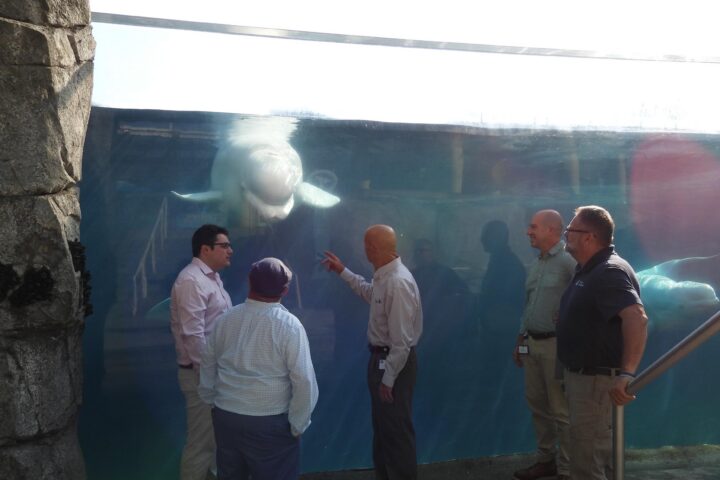
Quonset Point Donation Will Help Keep Mystic Aquarium’s Belugas Cool
Juno, the Mystic Aquarium’s convivial, photo-bombing Beluga whale, will continue swimming in cool comfort thanks to an unlikely chain of events that began 40 miles east in an Electric Boat industrial building at Quonset Point. That’s where EB’s Russ Tatro and Chris Logan were going over plans with a vendor, Carrier Corp., to replace Building...Continue reading→

EB Team Visits Hypertherm as Part of Drive Toward Modern, Efficient Shipbuilding
A team from Groton and Quonset Point headed to New Hampshire-based Hypertherm Associates this week to get a closer look at a modern automated plasma gouging process designed to streamline hull fabrication. The visit was part of a broader effort across Electric Boat to bring more advanced, state‑of‑the‑art manufacturing tools into the shipyard. EB plans...Continue reading→

Kamal Mohamed Recognized as 2026 Hartford Business Journal 40 Under Forty Award Recipient
The Hartford Business Journal (HBJ) 40 Under Forty Awards recognize outstanding young professionals in the Greater Hartford area who are excelling in their industries through their leadership roles. They are driven by success, motivated by challenges and are role models for their peers. These individuals are part of an outstanding class of upcoming business leaders...Continue reading→

Electric Boat Joins Regional Leaders for Military Appreciation Breakfast
Electric Boat employees joined military and community leaders for the Chamber of Commerce of Eastern Connecticut’s annual Military Appreciation Breakfast on Sept. 30 at Ocean Beach Park’s Port ‘N’ Starboard. The event provided more than 120 complimentary seats to active-duty service members from the Navy, Coast Guard and Connecticut National Guard. General Dynamics Electric Boat...Continue reading→

One Week Left—Let’s Claim the Torch! AHA Eastern Connecticut Heart Walk: Final Countdown
We are just one week away from the 2026 AHA Eastern Connecticut Heart Walk on October 3, 2026, at UConn Avery Point and this is our moment to finish strong. We’ve built incredible momentum, and now we’re within striking distance of something big. Right now, Electric Boat is holding second place, behind Mohegan Sun by...Continue reading→

803 Section 2B/5 Transported from Quonset Point to Groton
PCU Arizona’s (SSGN 803) Section 2B/5 was successfully delivered to Groton from Quonset Point. At 184 feet in length, this section – which includes the Virginia Payload Module (VPM) – is the largest Virginia-class shipment ever transported. Arizona, the first submarine to incorporate VPM, will be about 460 feet long upon final construction. Section 2B/5...Continue reading→

Remembering September 11
On September 11, 2001, the Twin Towers of downtown Manhattan’s World Trade Center and the Pentagon in Washington, D.C., were targeted in a series of coordinated attacks that would leave an everlasting imprint on our country’s psyche. As the events unfolded on that Tuesday morning, nearly 3,000 people lost their lives, over 600 were injured...Continue reading→

EBECSA Celebrates 75 Years — Nominate EB Employees Past and Present for Recognition
This year, the Electric Boat Employees’ Community Services Association (EBECSA) proudly celebrates its 75th anniversary. EBECSA was founded in 1951 by EB employees who wanted to create a dedicated, organized way to support nonprofit health and human service agencies in the communities where we live and work. What began as a small employee‑driven effort has...Continue reading→

Atlas Plaque Unveiled, Honoring Plank Owners at South Yard Ceremony
Employees who have worked on Atlas, EB’s new state-of-the-art floating dry dock, gathered in the South Yard on Wednesday, Aug. 26, to unveil a new bronze plaque recognizing the contributions of its plank owners. The event celebrated the teams who helped bring Atlas from Bollinger Shipyards in Louisiana to its arrival in Groton earlier this year. Atlas will play...Continue reading→

Neighbors Meet with EB to Discuss Noise, Lighting and Other Quality of Life Topics
Nearly twenty neighbors of Electric Boat’s Groton shipyard joined company leaders Aug. 25 for a community conversation focused on their quality‑of‑life concerns related to the South Yard Assembly Building (SYAB) and Atlas, the new floating dry dock. The Mayor of the City of Groton, Jill Rusk, also attended. Residents said they appreciated the chance to talk...Continue reading→