Disclaimer: Please note, the views in the podcast below are those of Dr. Jonathan Ward and do not necessarily represent those of the company.
Hi everyone; this is Kevin. Today is Monday, May 2nd (date recorded).
You’ve heard me talk about the Great Power Competition between the United States, China and Russia as the driving force behind the US Navy’s demand signal for more capable submarines. Today on the podcast I have a guest, Dr. Jonathan Ward, who has been studying Russia, China, and India for nearly the last twenty years. He is the author of China’s Vision of Victory and has been an advisor to the US Department of Defense, along with multiple other US government audiences, on China and Russia’s long-term strategy.
In two weeks, the Naval Submarine League will hold its annual submarine technology symposium during which Dr. Ward will be a featured panelist. Today we have an opportunity to get a preview of the messages Dr. Ward will share with the Navy and other members of the submarine community. So Dr. Ward, welcome to the podcast. Let’s start by giving our listeners a sense for the strategic objectives held by the communist party of China.
Dr. Ward: Thank you for having me here today, Kevin. Please call me Jonathan. The Communist Party has a long-term vision that they’ve made absolutely clear to the world though it mostly happens in their own documents and their own strategy for their national audience. They look to achieve what they call the great rejuvenation of the Chinese nation. This mission began at the founding of the People’s Republic of China in 1949. They see themselves having stood up and beginning an ascendancy. Prior to that, they believed that they had been humiliated by the world’s empires. And today the communist party has essentially inherited this mission of restoring China to greatness and really preeminence. The difference is that this in happening in a global system and global economy where military power can be projected around the world. So they see themselves ultimately as coming to dominate that international system as the world’s leading economy with unmatched military power, and they have a series of strategies that underpins that. That’s what we’ll be dealing with on the road ahead.
We just finished talking at the senior leadership level meeting about how China has been obvious and told us exactly what they’re about. If you look around here at Electric Boat, the modernization of its military is a key reason why you see the changing skyline here in Groton and at Quonset Point. We’re investing heavily in submarine production to counter the expanding military of China. So let’s talk a little bit about the relationship between China and our other great power military adversary, Russia. We’re all watching the Russian invasion of Ukraine unfold. From your perspective, what is the significance of this event in terms of the US’s competition with China?
This is an incredibly important event especially because it cements the Russia-China relationship for one important reason. Russia long ago during their invasion and annexation of Crimea essentially destroyed their relations with the Western world. At this point, anything that was left is now going to be gone, and they have one place left to turn and that’s China. So China has achieved this unprecedented thing where they have Russia, in a sense, ultimately in economic dependency. They’ve announced a no-limits strategic partnership. That partnership has been almost 20 years in the making with a foundation of the Shanghai Cooperation Organization in the early 2000’s. But they’ve deepened their economic and military relationships over the past two decades. At this point their ideological relationship is very firm and very joint in that sense. They’ve told the world that they intend to contest the US-led order and that they are going to do this as partners. We haven’t seen a partnership of this kind between Russia and China since the very early Cold War in the 1950’s. In many ways it’s a similar relationship but in reverse. Mao Zedong, after establishing the People’s Republic of China, went to Moscow to secure an alliance with Joseph Stalin for protection against the United States. The next thing that happened was the Korean War. Stalin said if you want to prove yourself as a partner, go handle this issue in Asia for me while I focus on Europe. So once again we have two major powers confronting us as partners on opposite ends of the Eurasian land mass, working together. I think China has reaped that benefit of essentially having Russia as a long-term economic dependency. But, at the same time, they’ve deeply degraded their relationship with Europe, which matters a great deal for their economic strategy. So there are weaknesses to what this means as a partnership, but we’re going to have to deal with the long-term consequences of an aligned Russia and China.
You talk a little bit about the fact that Russia and China are on the same path. I think you alluded to the potential for a second Sino-Russia split. Can you talk a little bit about what you mean by that—the ends may not be common to Russia and China?
So there’s a very interesting piece of their February 4 joint vision statement announced at the Olympics where Russia says that it recognizes that the People’s Republic of China sees the world ultimately as a community of common destiny for mankind. The Chinese side recognizes that Russia aspires to a multi-polar world. That’s where the visions diverge. Right now they are aligned in contesting the US-led order. They’ve pledged mutual support essentially for no NATO expansions. So China is willing to take on that ideological and propaganda piece. And then Russia has said that they believe Taiwan is an inalienable part of China. Where they diverge is the end state. China’s community of common destiny for mankind is a world that they see as the destination of the great rejuvenation of the Chinese nation where China is the dominant power in a hierarchical system. They sit on top economically and even militarily, and the rest of the world coheres around that vision. Whereas Russia is trying to get to a multi-polar world where they simply have more power and are on more of an equal footing with the West. For how long they can travel that road together, we shall see. I don’t think in the long run, ten years from now or perhaps longer, you have a Russia-China coexistence with Russia as such an inferior economic power. I think that’s ultimately the chance to break this up. But for now, they are very much partners in contesting the United States and our allies.
We talked a little bit about Ukraine—how do you think China is looking at what’s happening in Ukraine and what are they learning from the way the West is confronting Putin and the Russian government?
I think the most important thing that’s just happened is that China gets to witness the first real demonstration of Western economic warfare that’s happened in perhaps a generation. So the sanctions on Russia are much more strategic; these are not pinprick-type sanctions. They are much more fundamental and foundational. Going after Russian banks; cutting off Russia’s access to SWIFT (Society for Worldwide Interbank Financial Telecommunication); now the potential to terminate “most favored nation” status as a trading partner–all of this can isolate the Russian economy, and it’s already begun. Also, corporate flight from Russia is so important—we’ve seen hundreds of the world’s leading companies now terminate or suspend operations in Russia. That kind of corporate exodus shows China just what could happen if they use military power in their region. Their dependency on the world economy is far more significant to their national strategy than integration with the West is to Russia’s, ultimately. So China requires Western markets, Western capital and Western technology in order to continue on its rise to power. That’s the fundamental trade off—their military ambitions, which they very much have and which they’re preparing to ultimately act upon, I believe, are standing in a very difficult opposition to their economic dependency on the West. So we hold those cards. They depend on us much more than we depend on them, and we can properly use that at any time, whether slowly to create containment or rapidly to punish aggression. Those are very important cards that they have just watched with Ukraine.
Another important card for us is our industrial base associated with submarines and how important that is to national security. The folks from Electric Boat really form a lot of the core of the submarine community, along with our government. We’ve been working hard to build back what we lost during low-rate production and the fall of the Berlin Wall and the end of the Cold War where we saw less demand for submarines. Let’s talk about the impacts from China on our supply base and how important reindustrialization is to the US.
Kevin, reindustrialization is probably one of the most important pieces of a new US grand strategy. We’re going to need a new grand strategy really for the first time since the Eisenhower years. We had a strategy that enabled us to ultimately prevail in the Cold War against the Soviet Union, but we’ve not yet put one together for this contest. In this contest, victory really depends on economic power. What we’ve done–it’s such a terrible mistake and will be viewed, I think, by history as a very terrible mistake–was to allow our industrial base to migrate across the Pacific into our primary adversary’s borders. That is something that we now have to undo; we’re going to have to take a very broad view I think of reindustrialization in America. We’re going to have to become a manufacturing powerhouse once again. We’re going to have to do that with advanced technologies and make very substantial investments, I believe, so that the US can ultimately deal with these problems, but certainly reduce our dependency on our primary competitor. I believe that is all going to take shape first in the defense industrial base. That’s where this conversation has already begun. Of course, the shipbuilding industry base, given the vital importance of our Navy and our submarines to our national defense, that’s where this has begun. Eventually we’re going to have to do this across every industry that matters. That’s where the world economy changes–we reduce our dependency on China, we slow their growth, we rebuild this country, and that sets us on a path in the long run to win.
From my perspective, building back our manufacturing workforce is something that we are challenged with and are attacking every single day as we grow, not just our facilities but our workforce, at levels we haven’t seen in at least a generation of submarine builders. It’s a particular challenge especially as we see many of our long-serving employees retire. With them is a great amount of experience that goes out the door, and that means many, if not most, of our shipbuilders today have no personal memories of the Cold War. We’re a very much younger organization than we were just a few years ago. What would you say in closing to our people, and those considering working here, about the importance of the work they do bringing new submarines, with asymmetric capabilities that the Chinese can’t match today, to our US Navy given the competition we’re in with both Russia and China?
Fundamentally, the mission at Electric Boat is one of the most important missions in America and frankly, one of the most important in the world, in my opinion. Submarines are the cornerstone of our deterrence and our national defense. This is one of the domains where we have an advantage that our adversaries do not, and, therefore, this is just so essential to success in the most difficult geopolitical environment that we’ve faced since the early Cold War. I’m on the younger side as a millennial, but I’m also a Cold War historian, so I have the vantage point of seeing how dangerous the world can get as somebody who is from a younger generation. From that perspective, I would emphasize that anyone who sees the troubles that are brewing in the world today, who has a real sense of service and mission and the importance of long-term American victory and deterrence, Electric Boat is just essential for all of that. It’s very easy to understand–Electric Boat would be a place that people should be very honored to work.
I couldn’t agree more. I will say that having read your book, China’s Vision of Victory–and you have an accompanying book, America’s Vision of Victory, coming out soon–I will say that in my reading of it, it’s a heavy book. It’s worrisome. It makes you think about what we’re up against as a nation, as a free world really. But I do appreciate, toward the back of the book, there’s quite a bit about what we can do to push back and to make sure that what we see developing in China, and to a lesser extent in Russia, is not inevitable, so I appreciate your great work.
Thank you Jonathan, it’s been a pleasure to have you with us today at Electric Boat to share your insights. It’s important that our employees understand why the great work they do every day matters. We should never forget that in the grand scheme, we shipbuilders, while we are a very small group, we work to ensure the cause of freedom for more than 330 million Americans and countless others around the globe. Given the geopolitical forces that are at play, our warfighters must never lose the ability to win every fight now, so future generations of Americans will know the peace and freedom we enjoy now well into the future.
Thanks everyone; and thank you Jonathan, we’ll talk again soon.
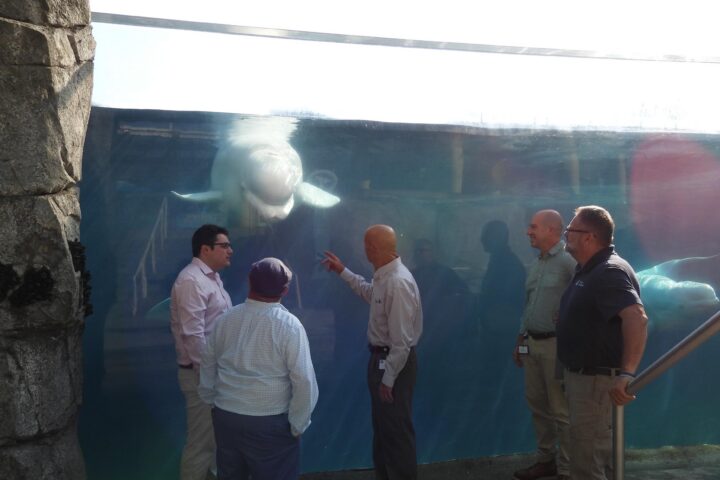
Quonset Point Donation Will Help Keep Mystic Aquarium’s Belugas Cool
Juno, the Mystic Aquarium’s convivial, photo-bombing Beluga whale, will continue swimming in cool comfort thanks to an unlikely chain of events that began 40 miles east in an Electric Boat industrial building at Quonset Point. That’s where EB’s Russ Tatro and Chris Logan were going over plans with a vendor, Carrier Corp., to replace Building...Continue reading→

EB Team Visits Hypertherm as Part of Drive Toward Modern, Efficient Shipbuilding
A team from Groton and Quonset Point headed to New Hampshire-based Hypertherm Associates this week to get a closer look at a modern automated plasma gouging process designed to streamline hull fabrication. The visit was part of a broader effort across Electric Boat to bring more advanced, state‑of‑the‑art manufacturing tools into the shipyard. EB plans...Continue reading→

Kamal Mohamed Recognized as 2026 Hartford Business Journal 40 Under Forty Award Recipient
The Hartford Business Journal (HBJ) 40 Under Forty Awards recognize outstanding young professionals in the Greater Hartford area who are excelling in their industries through their leadership roles. They are driven by success, motivated by challenges and are role models for their peers. These individuals are part of an outstanding class of upcoming business leaders...Continue reading→
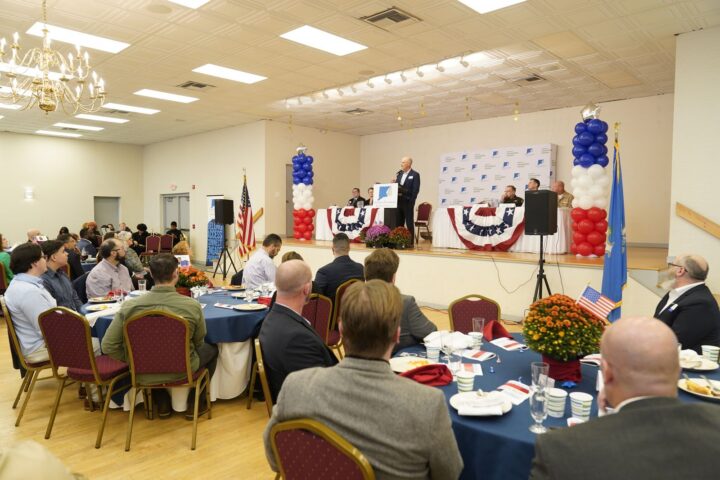
Electric Boat Joins Regional Leaders for Military Appreciation Breakfast
Electric Boat employees joined military and community leaders for the Chamber of Commerce of Eastern Connecticut’s annual Military Appreciation Breakfast on Sept. 30 at Ocean Beach Park’s Port ‘N’ Starboard. The event provided more than 120 complimentary seats to active-duty service members from the Navy, Coast Guard and Connecticut National Guard. General Dynamics Electric Boat...Continue reading→

One Week Left—Let’s Claim the Torch! AHA Eastern Connecticut Heart Walk: Final Countdown
We are just one week away from the 2026 AHA Eastern Connecticut Heart Walk on October 3, 2026, at UConn Avery Point and this is our moment to finish strong. We’ve built incredible momentum, and now we’re within striking distance of something big. Right now, Electric Boat is holding second place, behind Mohegan Sun by...Continue reading→
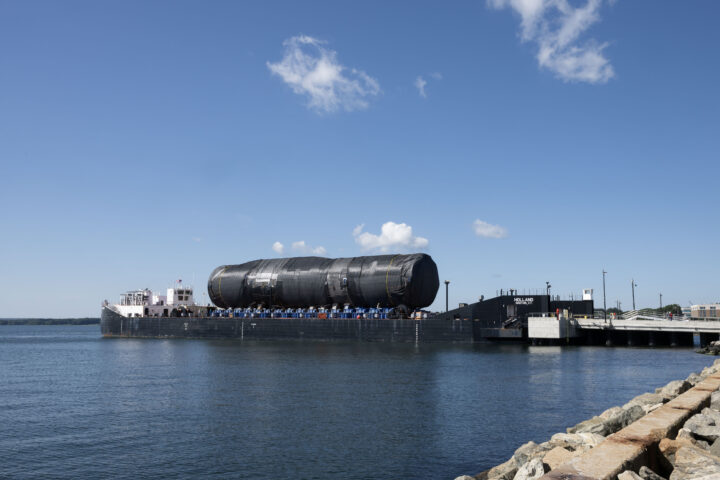
803 Section 2B/5 Transported from Quonset Point to Groton
PCU Arizona’s (SSGN 803) Section 2B/5 was successfully delivered to Groton from Quonset Point. At 184 feet in length, this section – which includes the Virginia Payload Module (VPM) – is the largest Virginia-class shipment ever transported. Arizona, the first submarine to incorporate VPM, will be about 460 feet long upon final construction. Section 2B/5...Continue reading→
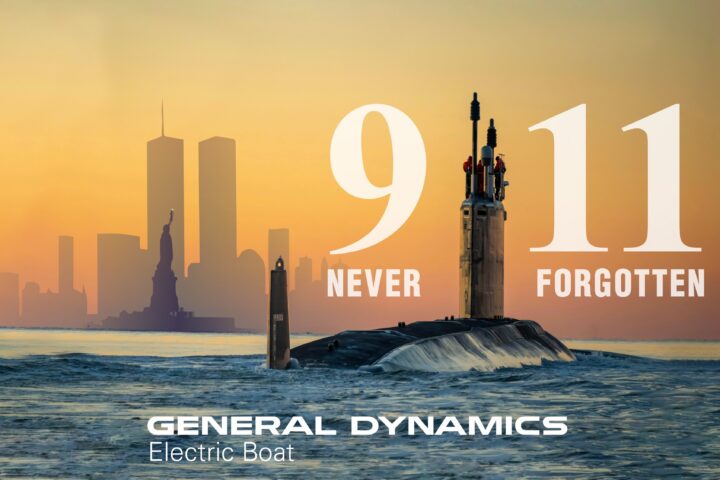
Remembering September 11
On September 11, 2001, the Twin Towers of downtown Manhattan’s World Trade Center and the Pentagon in Washington, D.C., were targeted in a series of coordinated attacks that would leave an everlasting imprint on our country’s psyche. As the events unfolded on that Tuesday morning, nearly 3,000 people lost their lives, over 600 were injured...Continue reading→
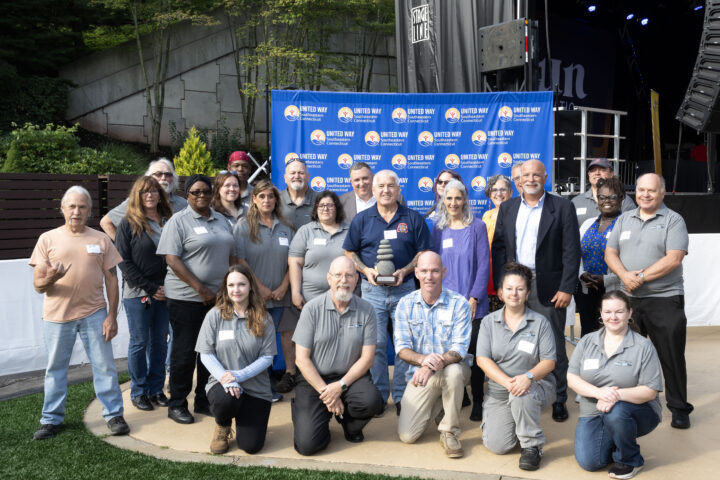
EBECSA Celebrates 75 Years — Nominate EB Employees Past and Present for Recognition
This year, the Electric Boat Employees’ Community Services Association (EBECSA) proudly celebrates its 75th anniversary. EBECSA was founded in 1951 by EB employees who wanted to create a dedicated, organized way to support nonprofit health and human service agencies in the communities where we live and work. What began as a small employee‑driven effort has...Continue reading→
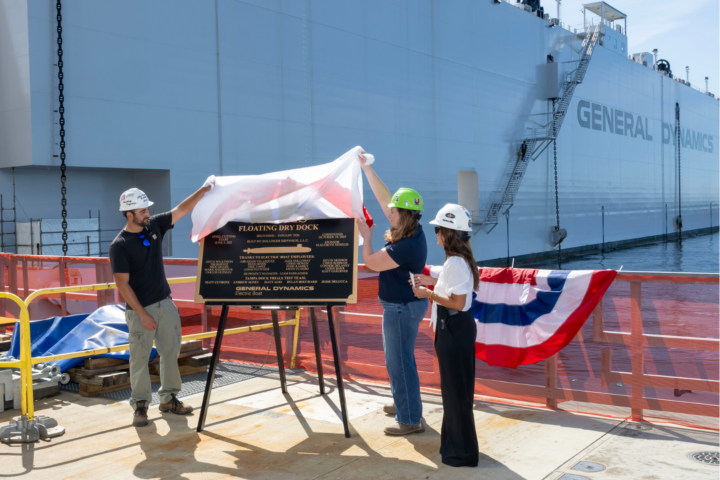
Atlas Plaque Unveiled, Honoring Plank Owners at South Yard Ceremony
Employees who have worked on Atlas, EB’s new state-of-the-art floating dry dock, gathered in the South Yard on Wednesday, Aug. 26, to unveil a new bronze plaque recognizing the contributions of its plank owners. The event celebrated the teams who helped bring Atlas from Bollinger Shipyards in Louisiana to its arrival in Groton earlier this year. Atlas will play...Continue reading→
Neighbors Meet with EB to Discuss Noise, Lighting and Other Quality of Life Topics
Nearly twenty neighbors of Electric Boat’s Groton shipyard joined company leaders Aug. 25 for a community conversation focused on their quality‑of‑life concerns related to the South Yard Assembly Building (SYAB) and Atlas, the new floating dry dock. The Mayor of the City of Groton, Jill Rusk, also attended. Residents said they appreciated the chance to talk...Continue reading→