
Hi everyone; it’s Kevin. It’s Tuesday, November 24th, my daughter’s 23rd birthday. Today I have Docs Hurley and Andrews on the podcast with me to talk about COVID. While it’s challenging to talk numbers since everything regarding COVID is changing so fast, the AP is reporting that the U.S. is now averaging more than 1,500 new deaths per day, according to data from Johns Hopkins. The seven-day rolling average for deaths was less than 1,000 just two weeks ago and is now 1,510. There have been close to 1.4 million confirmed deaths globally, and the U.S. has seen the most by far: almost 257,000. Given these sobering statistics, Dr. Andrews, let’s start by talking about the state of COVID-19.
Dr. Andrews: The state of COVID is worse now than in the spring. The rate of cases is increasing exponentially—for the latest statistics, as you said, people should check the John Hopkins web site. For the number of cases at EB, people can refer to EB Landing.
The curve of cases is going up sharply and the worst part is that Thanksgiving is this week with Christmas following in one month’s time. It is up to all of us to remain vigilant to stay healthy or avoid further spreading COVID.
The information on COVID comes fast and furious from all different sources: CDC, RI or CT DPH, Twitter, Facebook, and sometimes we even get our information from the guy standing at the water cooler. We get the news on radio, TV, computers, phones and sometimes in print, for us old-timers. The sources of information can be good or bad or somewhere in-between. It’s actually very hard to differentiate what’s fact or not fact. Unfortunately, some of the information can even be contradictory to other information, and what used to be facts are now even political in nature, which is another added layer. Everyone then synthesizes all of these sources, and each of us makes an interpretation. We all have opinions based on a compilation of information. With this assortment of facts and opinions, we all legitimize or rationalize our own actions. If you look hard enough or deep enough, there is enough information out there that anyone can validate their own opinions.
While statistics are telling, what I’d really like to touch on is COVID fatigue. I have used this term many times. However, at this point it is way more than just COVID fatigue. It is anger, sadness, loneliness, anxiousness, and madness. These are all real emotions and on any given day any one may have one or more of these feelings plus a host of other feelings. Sometimes these emotions get the best of us. If that happens, I want to remind people that we have the employee assistance programs, and if anyone feels that their emotions are out of control, or they just need help, they should by all means contact the EAP.
The good news is that people are surviving COVID more now than they did in the spring, and we all are hoping that an effective and safe vaccine is on the horizon. So there is good news, but we all still live our days with all these mixed emotions but remember there are still good things out there.
Thanks Doc, I appreciate the perspective you’re providing on emotional health and well-being of everybody going through this global pandemic. I know in my own family’s case, my daughter is out on the west coast in California. So we’ve been separated for just about a year, and a lot of that because of the travel restrictions. We’re finding that it’s very helpful that we talk, pretty much every day with each other just to check in and see how we’re doing. I think that’s important that we continue to do that with our family and friends—try and do as best we can with regard to that touch-time we get with folks to make sure that they’re all doing OK.
Dr. Hurley, let’s talk about the vaccine. We seem to be hearing something every day; most of it seems to be pretty positive–high efficacy rates and options from several companies. What’s the status as of today, and what’s your sense for how we will see the vaccines deployed?
Dr. Hurley: Pfizer, Moderna and now Oxford University have reported that their COVID-19 vaccines are up to 90% effective. They are not alone. There are at least 54 COVID-19 vaccines in development, six of which have received funding under the US Government’s “Operation Warp Speed.” While none of those are available in the United States, several potential vaccines have been shown to be effective against the Coronavirus.
Pfizer and its partner the German biotechnology firm BioNTech have reported that their synthetic messenger RNA vaccine is 90 percent effective at protecting participants in Phase III clinical trials. One drawback is that the vaccine needs to be kept at below-freezing temperatures. That makes it hard to transport and store. It would have to be administered soon after it is taken from storage or it loses its potency. It is anticipated that the cost for two doses per person will be around $39 dollars.
Moderna and the National Institutes of Health use a similar mRNA technology and announced the vaccine 94.5 percent effective in an interim analysis of late-stage clinical trials. It is easier to store, and it remains effective up to one month in a standard refrigerator. If you freeze the vaccine, it will last a little longer. Its anticipated cost is between $50-$75 dollars per person for two doses.
Finally, the British-Swedish company AstraZeneca and the University of Oxford have announced interim results from their 24,000-person Phase III trial. It found that the vaccine was 70% effective when the data from two different dosing regimens was combined. When given a half-dose followed by a full dose, 90% of individuals developed antibodies. The 90% rate was interesting–that actually less was more. When given two FULL doses, the efficacy rate was only 62%. Combined, 70% is still an efficacious vaccine and is promising, but like all the others, we’ll have to wait for the studies to be peer reviewed before we decide on which one to choose. Another reason to look at the Oxford vaccine is that it’s purported to reduce asymptomatic transmission. This means the vaccine not only helps stop people getting sick, but also helps to cut transmission rates of the virus.
The Oxford product differs from Moderna and Pfizer in that it is an adenovirus vaccine. It relies on a weaker version of a virus that causes the common cold in chimps that has been tweaked so it cannot grow in humans. Adenovirus vaccines are easier to store and transport. That’s why, unlike Pfizer/BioNTech or Moderna’s vaccines, which require very cold storage, the Oxford vaccine can be stored at fridge temperature.
At present, the specific roll out of these vaccines is changing rapidly. Yesterday at 3 p.m., Pfizer announced that they were requesting FDA Emergency Use Authorization for their vaccine. Their CEO announced that the vaccine would be distributed, “within hours” of getting this FDA-EUA approval. He believes the company can deliver 50 million doses by January and 1.3 billion by the end of the year. We are awaiting Moderna’s request for FDA approval.
Will these three be the only ones we’ll be able to choose from? It’s too early to say at this point, but certainly Pfizer and Moderna have a leg up in the US. We might not see the Oxford vaccine initially as they have agreements in place to supply both the UK and Australia. That having been said, they also are readying three billion doses of that vaccine.
If Pfizer’s is approved, rollout will start before Christmas, and the bulk of the vaccinations will occur from January through the end of the year in the US. Oxford’s vaccine is planning a rollout in the UK to start around Christmas. The UK Health Minister stated that the Country would be “back to normal” by Easter.
Certainly all of this is welcomed and encouraging news. Just another reason to continue staying safe until the vaccines are here.
Thanks Doc Hurley; appreciate the insight. I learned a lot about the similarities and differences between the vaccines that we’ve been hearing so much about in the news. The efficacy rates are certainly encouraging, and I hope the UK Health Minister is right—that we can look forward to being back to “normal” this spring. In the meantime, until the vaccines are available, we need to do whatever we can to stop the transmission.
Doc Andrews, in concert with our state and local leaders, we have been asking people to limit who and where they spend their holidays. Let’s talk about that.
Dr. Andrews: The holidays are notoriously hard on people. There are added expectations and added responsibilities, and that’s from a normal holiday season. Add COVID to the mix and we have something I cannot even describe. It is up to all of us to control our behaviors. Each of us must limit our social interactions—there’s no other way to put it. We have to put some limits on ourselves. I wanted to take a moment to discuss an area that still is a little confusing because it deals directly with people interacting with one another. If you are exposed to COVID, then you can develop the disease over the next 14 days, which is the incubation period. People often get tested during the incubation period, particularly if they had a known exposure. This is the important part—a negative test only tells you that you do not have the virus at that point in time. Bear with me; here’s an analogy.
If you drive over a nail with your car, then check the tire, the tire can look fine. This would be similar to being exposed to COVID and then having a negative test result. However, if you then drive around with the nail in your tire for a week, the tire may begin to lose air. So after a week or so if you recheck your tire, the tire might be flat. This would be equivalent to converting to a positive test later in the incubation period. I want to remind everyone that testing is important to find positive cases and pull them from circulation; however, a negative test does not give us permission to behave recklessly.
So please—stay within your group that you have already created. Continue to wear your face masks and maintain social distancing. Social distancing can be enhanced with opening windows or being outside. I know you’ve heard those from other places. Even at Thanksgiving—start opening the windows, particularly if it’s a warm day. Continue to wash your hands and surfaces. Something as simple as switching to using paper products may decrease how many dirty dishes one person has to touch.
We all will or have made sacrifices—some are big sacrifices while others are small or more mundane. Yet as bad as the sacrifice may be, we all want to remain hopeful and optimistic. Even with COVID, everyone can find something to be thankful for, so let’s remember that during the holidays. I want to wish everyone a safe and healthy holiday.
Thanks Doc. I appreciate you both taking the time to speak with us today before the holiday break.
As a reminder, if you have any questions about our COVID procedures and policies, you can find what you need on our COVID-19 Updates page on Homeport. You can also reach out to your HR Business Partner.
Thanks to all of you for listening. Have a safe, healthy, and restful Thanksgiving.
We’ll talk again soon.

Building the Future: EB’s New Central Distribution Hub
In April, Electric Boat (EB) began construction on the new central distribution hub for its warehousing, shipping, and receiving operations at 45 Frontage Road in North Stonington, CT. Since then, the 480,000‑square‑foot next‑generation warehouse facility has quickly taken shape. All wall panels are now complete, and construction is ahead of schedule. The facility will celebrate...Continue reading→

Delivering the Future
Some imagine the future. We deliver it now.
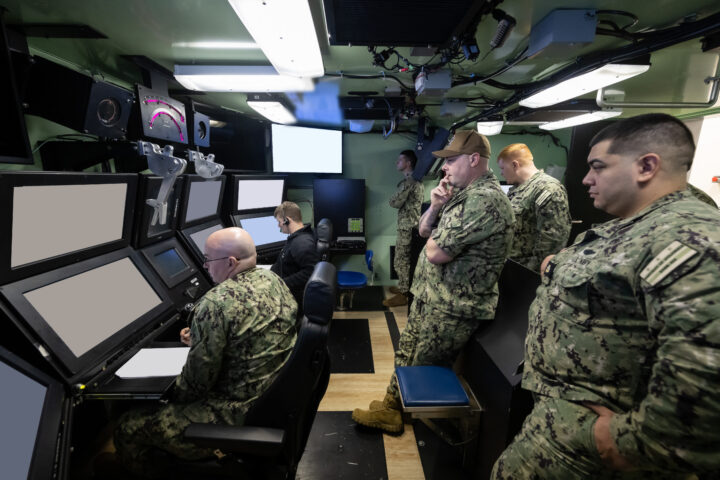
State-of-the-Art Simulator Prepares District of Columbia Crew for its Mission
As construction of the District of Columbia (SSBN 826) continues apace in EB’s South Yard Assembly Building, the sailors who will soon be at the controls are spending hours in a dynamic, high-tech simulator learning the intricacies of operating the 21,000-ton, first-in-class boomer. The Columbia Ship Control Operator Trainer (CSCOT) is a replica of the...Continue reading→
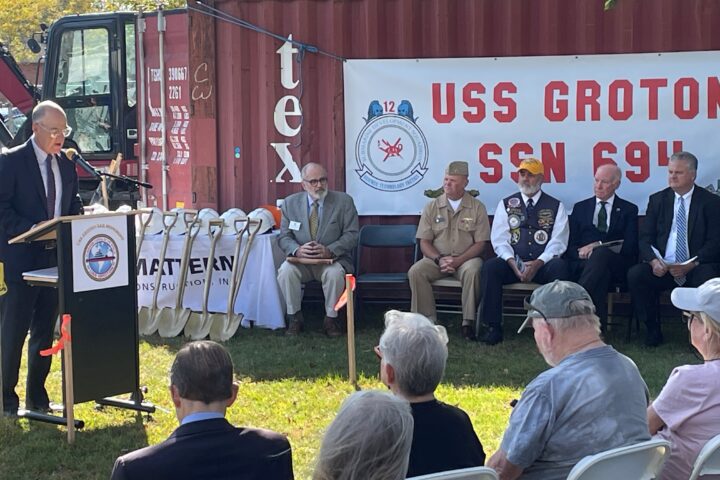
Groundbreaking Ceremony Marks Start of USS Groton Sail Monument
Fifty years after the USS Groton (SSN‑694) first launched, dozens gathered outside the Groton Public Library Oct. 9 to celebrate the groundbreaking of the USS Groton Sail Monument. The $6.6 million project—three decades in the making—will honor the men and women who design, build, operate and maintain the Navy’s submarines, as well as the families...Continue reading→

A Celebration of Heart, Community and Victory
2026 American Heart Association Eastern Connecticut Heart Walk Recap Saturday, October 3, 2026 | UConn Avery Point The 2026 American Heart Association Eastern Connecticut Heart Walk at UConn Avery Point was nothing short of extraordinary. Under bright autumn skies, 26 incredible Electric Boat teams and 151 walkers came together with passion, purpose, and unstoppable energy...Continue reading→
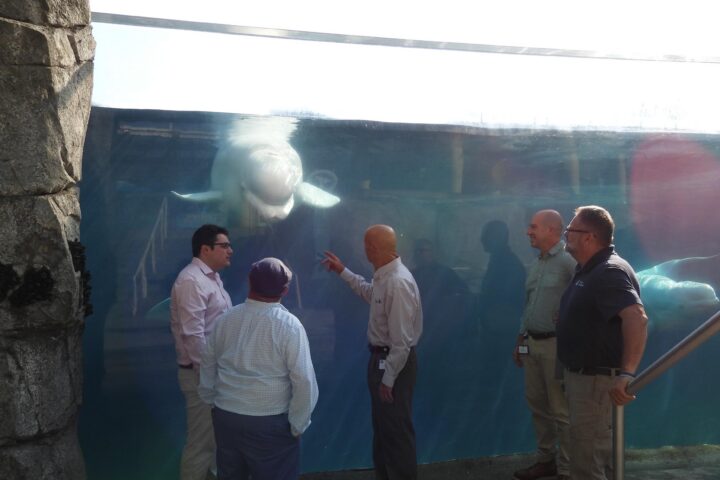
Quonset Point Donation Will Help Keep Mystic Aquarium’s Belugas Cool
Juno, the Mystic Aquarium’s convivial, photo-bombing Beluga whale, will continue swimming in cool comfort thanks to an unlikely chain of events that began 40 miles east in an Electric Boat industrial building at Quonset Point. That’s where EB’s Russ Tatro and Chris Logan were going over plans with a vendor, Carrier Corp., to replace Building...Continue reading→

EB Team Visits Hypertherm as Part of Drive Toward Modern, Efficient Shipbuilding
A team from Groton and Quonset Point headed to New Hampshire-based Hypertherm Associates this week to get a closer look at a modern automated plasma gouging process designed to streamline hull fabrication. The visit was part of a broader effort across Electric Boat to bring more advanced, state‑of‑the‑art manufacturing tools into the shipyard. EB plans...Continue reading→

Kamal Mohamed Recognized as 2026 Hartford Business Journal 40 Under Forty Award Recipient
The Hartford Business Journal (HBJ) 40 Under Forty Awards recognize outstanding young professionals in the Greater Hartford area who are excelling in their industries through their leadership roles. They are driven by success, motivated by challenges and are role models for their peers. These individuals are part of an outstanding class of upcoming business leaders...Continue reading→
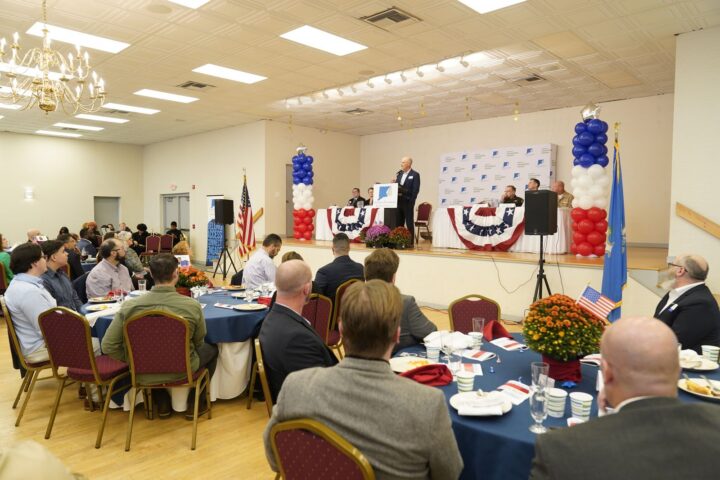
Electric Boat Joins Regional Leaders for Military Appreciation Breakfast
Electric Boat employees joined military and community leaders for the Chamber of Commerce of Eastern Connecticut’s annual Military Appreciation Breakfast on Sept. 30 at Ocean Beach Park’s Port ‘N’ Starboard. The event provided more than 120 complimentary seats to active-duty service members from the Navy, Coast Guard and Connecticut National Guard. General Dynamics Electric Boat...Continue reading→

One Week Left—Let’s Claim the Torch! AHA Eastern Connecticut Heart Walk: Final Countdown
We are just one week away from the 2026 AHA Eastern Connecticut Heart Walk on October 3, 2026, at UConn Avery Point and this is our moment to finish strong. We’ve built incredible momentum, and now we’re within striking distance of something big. Right now, Electric Boat is holding second place, behind Mohegan Sun by...Continue reading→