Hi everyone; today is Friday, April 22nd and marks the 52nd celebration of Earth Day in the United States. Earth Day was created to raise awareness about our impact on the environment and our need to mitigate those impacts through regulations and personal accountability.
Today I’m joined by Mike Sinko, our Senior Manager of Environmental Resources, and Marie Martin, Supervisor of Environmental Engineering at Quonset Point, to talk about EB’s environmental programs and how they align with this year’s Earth Day theme, “Invest in Our Planet.” At Electric Boat, being responsible for the environment means we are good neighbors and responsible stewards of the natural resources at all of our locations.
So Mike and Marie, welcome to the podcast. Our employees should be proud of the strides we’ve made to reduce our impact on the environment. Let’s begin by talking about what we’ve done to reduce greenhouse gases. Mike, why don’t you start us off.
Mike: Thank you Kevin for having us. In 2021, General Dynamics set a goal to reduce its Scope 1 and Scope 2 absolute greenhouse gas emissions by 40% from a 2019 baseline before the end of 2034, and EB accepted the challenge. Scope 1 emissions are those generated directly from sources operated by EB, such as heating plant boilers, vehicles and generators. Scope 2 emissions are indirect, from the production of energy consumed by EB, such as electricity. Absolute emissions means the 40% reduction must be achieved regardless of growth. Considering EB’s current outlook for growth, this will be a major challenge, and will require everyone’s help and some creative thinking.
I agree with that. It is going to be a challenge given the rate at which we’re growing, and we all have a role to play in this. I know EB has no shortage of smart, creative people who are good at solving problems just like this. I encourage people to reach out to you and your teams with ideas. You’ve formed a committee focused on evaluating our current emissions and defining the path forward to achieve that 40% reduction by 2034. Let’s talk about what the committee is doing, Marie why don’t you start us off there.
Marie: We want to start out by conducting energy efficiency audits of some of our existing and older buildings, facility systems and equipment to better understand their energy usage and identify energy reduction opportunities. The information gained from the audit will better prepare EB to align all future facility improvement efforts with our goal of greenhouse gas reduction. For example, the recent replacement of four steam boilers in the Groton shipyard’s main heating plant reduced EB’s greenhouse gas emissions by 9% of our 2019 baseline. So if we’re trying to reach the reduction of 40% by 2034, we’re off to a good start.
This effort not only reduces EB’s greenhouse gas contribution, but it also improves air quality in the surrounding communities. We also have several other small- and large-scale upgrades already in the works to achieve further reductions. Plus, all of the new buildings and systems being constructed have been designed with energy efficiencies in mind.
You mentioned our newest buildings. General Dynamics has made significant capital investments—about $1.8 billion—into our new facilities, and sustainability plays a key role in our thinking as we erect these buildings and develop new processes. So Mike, let’s talk a little more about that.
Mike: One example is solar panels. It is a longer-range goal of ours to evaluate the feasibility of solar panel leasing because all of our new buildings are structurally capable of handling solar panels. Another example is that all of our new QP buildings have storm water treatment which treats over 90% of the storm water runoff. Also at QP, we’ve installed fume mitigation equipment in six buildings, covering 720,000 sq. ft. of operational areas, collecting 70% of the hot work emissions produced by processes such as welding, grinding and gouging.
Another key point, and I know you and Matt Luxton shared this on a previous podcast, but it does bear repeating, is that having streamlined processes means we’ll use fewer natural resources. So having a dedicated South Yard Assembly Building, where we’re consolidating everything into one location for Columbia, will translate to a much greater environmental reduction for the company, considering things like energy consumption and air emissions. In addition, Atlas, our future floating dry dock, currently under construction at Bollinger shipyard, will require much less water discharge as opposed to the graving dock process we currently use.
Other longer-range projects we’re considering to further reduce our footprint include purchasing green, renewable energy; use of bio-fuels and converting to electric vehicles. In fact, just this week, one of our employees, a Department 459 designer, reached out to me asking if we were thinking about adding electric vehicles to our transportation fleet.
Thanks Mike, those measures we’ve made will have a significant impact, and it’s great that your team is evaluating additional changes we can make to do even better from an environmental perspective. Let’s take a minute to remind our folks about the simple things we can all do at work and at home to be good environmental stewards. Marie…
Marie: At work, a few things people can do are report leaking air tools to their supervisor or the tool crib, turning off equipment when practical, or closing containers of hazardous material when they are not being used. There are also several great ways to be personally accountable away from work, like receiving a home energy audit to maximize efficiencies throughout your house, staying on top of routine vehicle maintenance to improve fuel efficiency, or possibly move towards a plant-rich diet.
Carpooling is also a good idea to save on gas, or paying attention to buying only what you NEED can reduce the volume of waste you produce, and acquiring those items you DO need locally, whenever possible, to reduce the carbon footprint produced by out-of-state shipping. Finally, now that it’s getting warmer outside, you can volunteer for an environmental outreach program to help clean-up your local community.
These simple things do not take a great deal of effort, but when you add them up, they do actually make a difference.
Thank you both for joining me today for this Earth Day podcast. I think we have a lot to be proud of in terms of what Electric Boat is doing to reduce our environmental footprint and maintain our role as good stewards. I also know we can count on the resourcefulness of our folks to come up with new ideas for doing even better to reach our corporate goal of reducing emissions 40% by 2034.
Thanks for joining me today. Happy Earth Day to everyone; we’ll talk again soon.
Safety Update: Installation of Speed Tables on Eastern Point Road
In an effort to increase safety at Electric Boat’s Groton shipyard, two speed tables are being installed across Eastern Point Road this week. The tables, a few inches tall and marked with yellow stripes, are designed to slow vehicle traffic in an area frequented by pedestrians. The first speed table crosses Eastern Point Road just...Continue reading→
EB firefighters recognized for life-saving rescues
Five members of the Electric Boat Fire Department in Groton were recognized for perilous, life-saving rescues during a pair of multi-alarm fires that engulfed apartments in Groton and New London in 2025. Firefighters Thomas Gugliotti, Arthur Keaten, Theodore Bartkoski, James Brady and Capt. Ryan Boulanger were each presented with Lifesaving Awards and the prestigious 2026...Continue reading→

The Barnacle: Parking Enforcement That Sticks
Meet the Barnacle, Electric Boat’s newest parking-enforcement tool that will begin deployment in the Groton shipyard starting Monday, June 15. As our enterprise continues to grow, we are dedicated to ensuring parking is safe, fair and accessible to all. The Barnacle is an immobilizing parking-enforcement device that attaches directly to a vehicle’s windshield using heavy-duty,...Continue reading→
Honoring the U.S. Army Birthday
June 14th marks the 251st Birthday of the United States Army, a moment to honor the enduring legacy, bravery, and sacrifice of those who have worn the Army uniform since 1775. As the oldest branch of the U.S. military, the Army has played a vital role in shaping our nation’s history and safeguarding its freedoms....Continue reading→
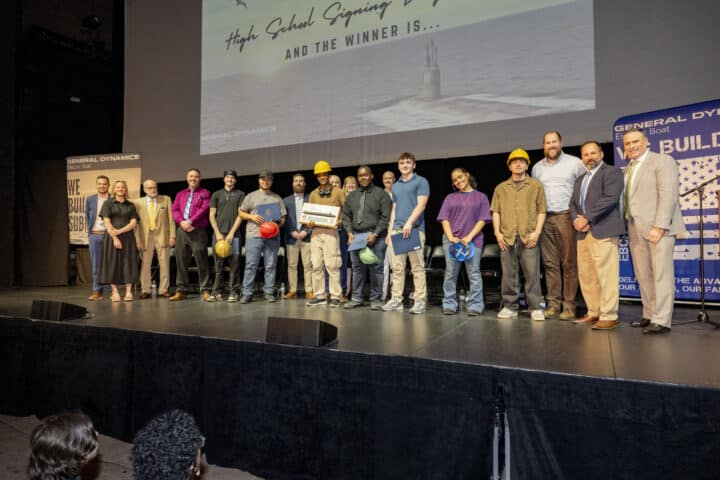
Rayha Report Ep. 20: 2026 EB Signing Days
Electric Boat held recent Signing Day ceremonies at Cranston West High School on May 21 and the Garde Arts Center in New London on May 28. EB President Mark Rayha spoke with students about their decision to join EB and educators who prepare their students for careers in shipbuilding. Click here to see the latest installment of the Rayha...Continue reading→
Save the Date: CT Health Fairs Kick Off June 9
A Message From Dan Vieira and Kathleen Heller At EB, Safety and Wellness go far beyond meeting basic compliance standards. Our focus is on building a culture where employees can thrive in every aspect of their lives. Prioritizing wellbeing is vital to being our best on the job and at home with our families. ...Continue reading→
Supporting Our Neighbors Impacted by The Ledges Apartments Fire
Early Sunday morning, a devastating fire occurred at The Ledges Apartments in Groton. Eighteen fire departments, including Electric Boat’s, responded. Thanks to the heroism of these first responders no residents were injured. The fire did, however, displace more than approximately 50 residents and destroyed or damaged 44 units in the building. Several EB employees were...Continue reading→

Pride Month Celebrations at Electric Boat
June 1st marks the start of Pride Month, a time for millions of LGBTQ+ individuals and allies around the world to come together in celebration and reflection. From film festivals and art shows, to marches and concerts, Pride is a vibrant tribute to LGBTQ+ culture, history and the relentless spirit of activism. It’s a chance...Continue reading→
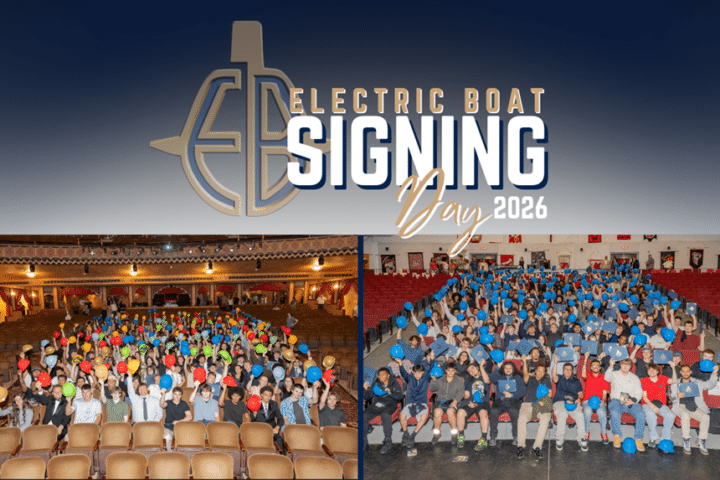
Celebrating Our Next Generation of Shipbuilders
The Next Generation of Shipbuilders Takes the Stage Over the past two weeks, Electric Boat welcomed the next generation of shipbuilders at our Rhode Island and Connecticut Signing Day celebrations, marking the beginning of a journey that will help shape the future of our company and our nation’s defense. Held at Cranston High School West...Continue reading→
Update: Gold Star Bridge Project – Upcoming Traffic Impacts
CT DOT is preparing to enter the next major phase of the Gold Star Memorial Bridge Rehabilitation Project, and employees should expect new traffic patterns that may affect travel to and from EB’s Groton and New London facilities. A crossover will direct two northbound lanes onto the southbound bridge, as shown in this CT DOT...Continue reading→