
Hi everyone; it’s Kevin. Today is Friday, February 18th (date recorded). General Dynamics just announced its 2021 financial results and held its earnings teleconference with the analysts that cover our stock a few weeks ago. Mark Rayha, Electric Boat’s VP and our Chief Financial Officer, is with me today, so welcome back Mark. Let’s break down some of the concepts and terms we see in an earnings report into some plain English. To start, we’ll talk about how Electric Boat impacts how investors see GD as a whole and how we impact the GD share price.
Absolutely, Kevin, it’s great to be here. EB is one of the most visible companies within the GD portfolio. Not only do we make the most consequential product available to the US DoD (Department of Defense), we are a large part of the growth story that makes General Dynamics stock very attractive to investors. Fundamentally, investors seek the highest return at the lowest risk. Even in this world with internet chat boards and meme stocks that create wild swings in share prices, most investors still look for companies with strong and durable demand for its products with a demonstrated ability to meet that demand. Operational excellence is in the DNA of all the GD business units, and it’s an ongoing theme at all levels of leadership. Companies like EB that have a long history of delivering on-time and on-budget are, therefore, very attractive. When you combine a reputation for excellence with the level of work that we have on contract, EB represents a great value opportunity to an investor. For those of us that own shares of GD stock through our 401k funds or through other means, we are creating that long-term wealth for our shareholders and for ourselves.
Phebe (Novakovic, GD’s CEO) talks about it with us all the time, and the point about operational excellence being in our DNA is something that’s critically important and a hallmark of all the GD business units. Here at EB, our backlog and the opportunity it creates for every member of our team is really at a historic level. We will be building Columbia submarines through the 2040 timeframe, and the Navy’s need for attack submarines has never been greater. That’s as a result of the great power competition with Russia and China. There are no signs of that letting up, so there is strong and durable demand for our products. Let’s talk about how that translates into GD’s investment into our business. Why would the corporation choose to invest in us?
As you said, General Dynamics and the US Navy have invested a significant sum of cash capital to facilitate our ability to produce both Columbia and Virginia at the same time. A company the size of General Dynamics has many options for where to allocate its scarce capital, and it bases its decisions on where to invest on the financial return that investment provides or the expectation of where that investment will pay back. The fact that the General Dynamics Board of Directors approved close to $2 billion in investment in our business is a clear indication that they believe in this business’s ability to make significant money using those new facilities. Our job is to provide that return on investment by delivering our products on time and within the budgets, of course considering that our priorities are always safety, quality, schedule and cost, in that order. It takes each one of us doing our part every day to ensure that occurs.
So when we get through earnings season like we just came through for 2021, we hear a lot of terms thrown around, and when you read investor briefs or analyst articles about GD, the focus is always on earnings and cash flow. Let’s talk about a few of those concepts for those who are not as familiar with those measures and how they are used to gauge our financial performance.
Sure, let’s start with our earnings. Earnings is the difference between the price that our customer pays for our product and what it costs us to make it. Many of us have heard of the term “earns” or “earned hours” in the context of our day-to-day work building submarines. Earning those hours—getting the work done at or below the target for that work order—is how we make money. That “money” is “earnings” from a financial reporting or financial markets standpoint. Obviously our skilled trades work many work orders in any given day, and there are thousands worked on each submarine, but the basic equation is always the same. Rework or any other hold-up that causes a shipbuilder to unnecessarily stop working negatively impacts our ability to make money.
Now let’s talk about cash. Cash is the lifeblood of any business, large or small. Any business needs to generate cash to fund purchases of the equipment, tools, raw materials and other components it needs to build its products.
The earnings and cash we have generated in the past provide the funds for all of the investment we are making in the business now. Training and development and large capital assets like the South Yard Assembly Building, the Holland barge, the Atlas floating dry dock and the numerous buildings at Quonset Point are all being paid for with the earnings and cash we generated in the past.
That’s important to recognize. There’s a legacy that we’ve inherited from others, and we build on that legacy as shipbuilders. It’s always important to keep that in mind. For example, when we look at the South Yard Assembly Building taking shape, and the other large investments we need to construct and deliver Columbia, think about our seasoned shipbuilders who worked hard to deliver on the Virginia program from its start. Their hard work gave them, first of all, a career, and I know personally there’s a lot of pride that comes from supporting our nation’s defense. I see it in every individual I talk to in the shipyard. Thirdly, it gives a legacy of investment into our future. So the work we’re doing today really sets the stage for the future shipbuilders. That’s pretty awesome to think about. So we inherit that legacy, and we leave on a legacy.
So Mark, I think it will be helpful to continue this conversation periodically. I think we need to continue to build our collective “Finance 101” muscle, that is, our knowledge as an organization on what makes the organization tick from a financial perspective. Any final thoughts to share before we close?
I think the thing that comes to mind is the financial markets can get complicated, and there are many things that impact the GD stock price that we can’t control, so we shouldn’t worry too much about that. We just have to control what we can. We are the best in the world at delivering an incredibly sophisticated product. Not many people can go home each day knowing that they helped build a product that keeps the entire world safer. One of our strengths as a business is how our people do what it takes and rise to the occasion in moments of truth. Building on that reputation for excellence and getting better each day in completing our work on time and within budgets, meeting our commitments to each other, and continuing to deliver the most important national security product to our sailors and our nation is how we will continue to reward anyone that invests in General Dynamics.
Thanks Mark, and thanks everyone for listening. We’ll talk soon.
EBECSA Celebrates 75 Years — Nominate EB Employees Past and Present for Recognition
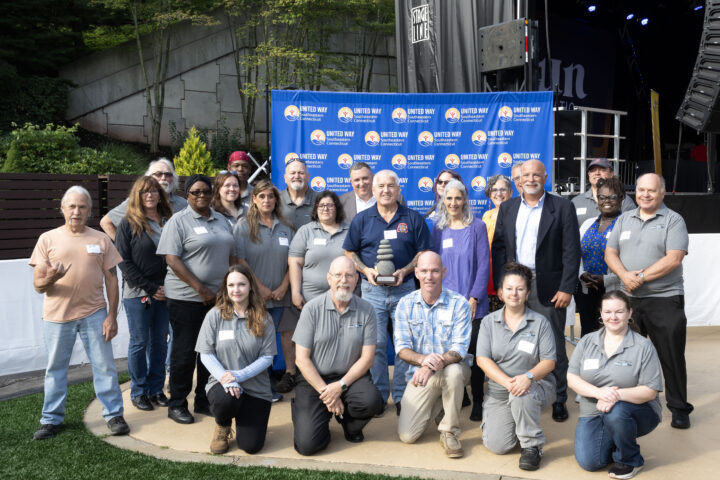
This year, the Electric Boat Employees’ Community Services Association (EBECSA) proudly celebrates its 75th anniversary. EBECSA was founded in 1951 by EB employees who wanted to create a dedicated, organized way to support nonprofit health and human service agencies in the communities where we live and work. What began as a small employee‑driven effort has...Continue reading→
Atlas Plaque Unveiled, Honoring Plank Owners at South Yard Ceremony
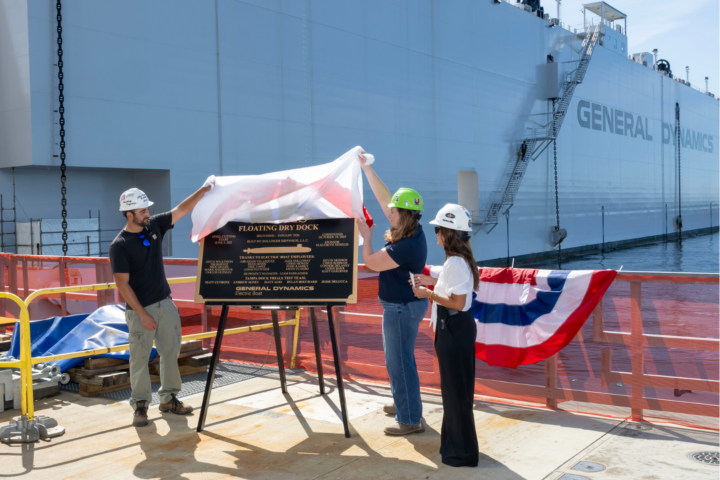
Employees who have worked on Atlas, EB’s new state-of-the-art floating dry dock, gathered in the South Yard on Wednesday, Aug. 26, to unveil a new bronze plaque recognizing the contributions of its plank owners. The event celebrated the teams who helped bring Atlas from Bollinger Shipyards in Louisiana to its arrival in Groton earlier this year. Atlas will play...Continue reading→
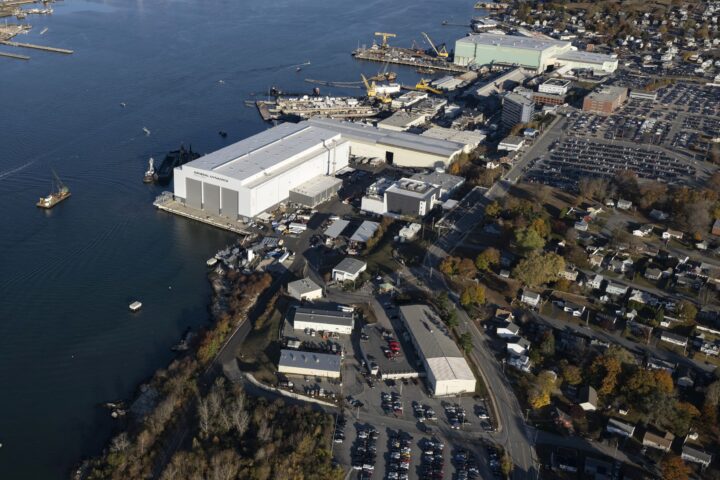
Neighbors Meet with EB to Discuss Noise, Lighting and Other Quality of Life Topics
Nearly twenty neighbors of Electric Boat’s Groton shipyard joined company leaders Aug. 25 for a community conversation focused on their quality‑of‑life concerns related to the South Yard Assembly Building (SYAB) and Atlas, the new floating dry dock. The Mayor of the City of Groton, Jill Rusk, also attended. Residents said they appreciated the chance to talk...Continue reading→
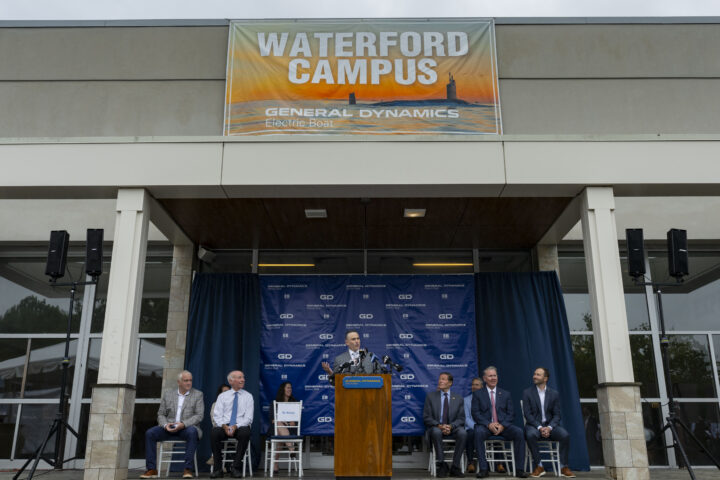
Rayha Report Ep. 26: Waterford Campus Groundbreaking
EB President Mark Rayha reports from the groundbreaking of the new Waterford Campus, where innovation, engineering and workforce development will come together to support our mission. The new facility will help train hundreds of shipbuilders daily as EB continues to grow for future production demands.
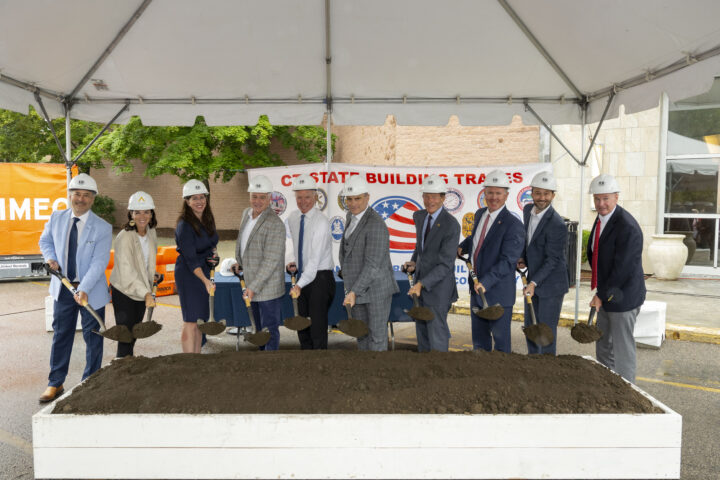
Waterford Campus Groundbreaking Marks EB’s Next Step in Innovation and Workforce Growth
Electric Boat officially broke ground Friday on the Waterford Campus, launching the transformation of the former Crystal Mall into a center for innovation, engineering and high‑tech workforce development. EB President Mark Rayha underscored how the project will reshape the way the company designs, tests and builds submarines. Innovation is the key, he said. “There’s an opportunity to...Continue reading→
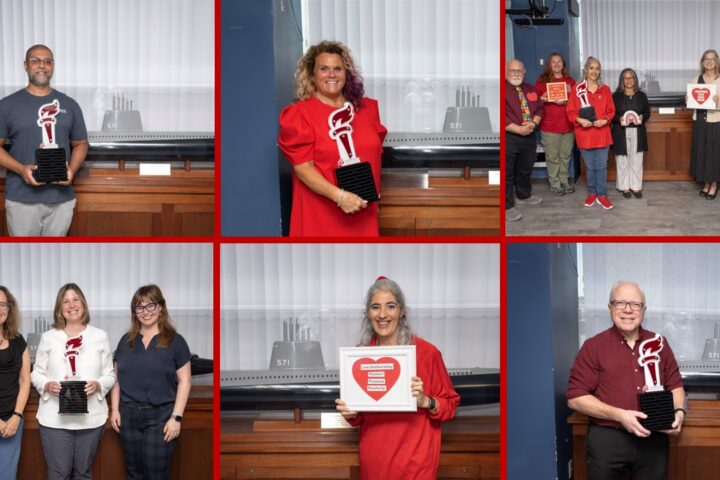
Powering HeartStrong 50: Thank You, EB Teams—Let’s Keep the Momentum Going!
Thank you to our incredible EB Heart Walk teams, our community partners, and everyone who joined the American Heart Association (AHA) Torch Journey photoshoot. Your enthusiasm and dedication made this milestone truly special. Now let’s keep our HeartStrong 50 energy going—our goal is 50 teams and $50,000 raised for the 2026 AHA Eastern Connecticut Heart Walk on October 3 at UConn Avery...Continue reading→

Speed Cameras to be Installed in the City of Groton
The City of Groton Police Department announced that automated speed enforcement cameras will be installed at several locations throughout the city. The cameras will be installed after the required 30-day public notification period, which began on Aug. 7, 2026. Camera locations: Mitchell Street Thames Street Clarence B. Sharp Highway (Route 349) Police said the purpose...Continue reading→
MDA Apprenticeship Application Now Open
Application Window: August 1, 2026 – August 31, 2026 The MDA Apprenticeship Program is a four-year initiative designed to develop a highly skilled workforce for Electric Boat. This program provides three years of on‑the‑job training alongside qualified subject matter experts, combined with classroom instruction across various technical disciplines. Participants gain advanced skills, broaden their expertise, and...Continue reading→

Building 600 Tech Stop Relocation
On Monday, August 3, 2026, Facilities will be relocating the Tech Stop currently located in Building 600 4th Floor East to its new location in Building 130-01 Classroom 7. During this time, please utilize the alternate Tech Stop location: B708 (625 Long Hill Road) Hours: Monday – Friday: 7:00 am – 3:00 pm The tech stop will resume...Continue reading→

A Message From Mark Rayha: Historic Contracts/Rayha Report
Today marks one of the most significant moments in Electric Boat’s history. As part of its $76.6 billion submarine contract announcement, the U.S. Navy has awarded Electric Boat ship construction contracts valued at $29.5 billion for five Columbia-class submarines and $42.1 billion for nine Virginia-class submarines, along with incentives for shipyard infrastructure. Click here to read the...Continue reading→