
This is Kevin; today is Wednesday, August 4. On today’s podcast I’m speaking with our EB physicians Doc Andrews and Doc Hurley.
Thank you both for joining the podcast. As physicians, you have been on the front lines managing this pandemic. You are resources we’ve grown to trust for the simple truths on getting through this.
There’s been a lot of confusion in the last couple of weeks with the spread of the delta variant of COVID. In my podcast on Monday I emphasized the importance of vaccines in controlling this pandemic. Some people are hesitating to get vaccinated because they think the vaccines were developed quickly and are, therefore, experimental. The technology behind the Pfizer and Moderna mRNA vaccines is new, but not unknown. Let’s talk about that as well as the technology behind the J&J viral vector vaccine.
Dr. Andrews: There is a lot of material on the CDC and the public health websites explaining how the vaccines work, sometimes I’d say there’s even too much material. So I will try to simplify the information. Let’s start with the mRNA vaccines that teach our cells how to make proteins that trigger an immune response inside our bodies. This immune response produces antibodies which are the items that actually protect us from getting infected if the real virus enters our bodies.
The mRNA vaccines trigger our cells to produce a harmless protein, called the spike protein. The spike protein is also located on the surface of the COVID virus. Our cells display the spike protein, then our immune response recognizes that the protein does not belong there and begins building an immune response with antibodies.
In this way we have taught our cells to identify and fight the COVID virus.
Alternatively, vector vaccines like the J&J vaccine contain a modified version of a different virus than COVID-19. Inside the shell of the modified version is a piece of material from COVID-19. This unit is called the viral vector. Once the viral vector is inside our cells (and I mean that to be not the COVID-19 virus), then our cells make copies of the unique protein. Our T and B lymphocytes will remember this unique protein and fight it if we are infected in the future.
The biggest difference in the two vaccines is the first stage of the immune response. One relies on mRNA while the other relies on a vector to start the process of building spike proteins that will trigger our immune system to produce antibodies that ultimately recognize if COVID-19 enters our body.
It is also important to remember that just because the vaccines were developed fast, no steps were skipped in the process of making them.
Thanks Doc Andrews, appreciate that explanation. The media has been focusing on breakthrough infections among the vaccinated with this delta variant of COVID. How rare are breakthrough infections, and when they do occur, how sick do people get, generally?
Dr. Hurley: A breakthrough case means that someone who has been fully vaccinated and has waited two weeks to develop full immunity still contracts COVID-19. Breakthrough infections are actually expected. While the vaccines have proven highly effective against the virus, even for new variants like the delta, they do not offer perfect protection. That’s one of the reasons why the Centers for Disease Control and Prevention last week revised its guidance and recommended that in places with high rates of transmission such as Oklahoma, even vaccinated people should wear masks in public indoor settings.
The good news is that vaccines have been found to be extremely good at preventing serious illness and death. Of those hospitalized with the virus, more than 97% are the unvaccinated. The CDC estimates that for every 102,000 vaccinated individuals, only 100 end up hospitalized, and only one will die. While those numbers are not perfect, they are very, very good.
If vaccinated people come down with infections, the vast majority will be asymptomatic or mild. Nonetheless, they may still be able to spread the virus to others before their immune system, which has been primed by the vaccine, stamps it out. Preliminary data suggest that when people do get breakthrough infections, they carry a high amount of the virus for at least one week.
As with the original strain of the coronavirus, dose seems to matter with the delta variant. The higher the load of viral exposure—think of a brief masked encounter versus spending hours and hours unmasked in a room with an infected person—with the high viral exposures, the more likely immune defenses will become overwhelmed and result in a symptomatic or serious infection.
Currently the data shows that with 163 million people in the US fully vaccinated, you can expect up to about 125,000-and-change breakthrough cases. The data is still coming in, and this number can be found as low as 7,000 and beyond 125,000, and this is as of July 30. What it translates to is about .08% or one in every 1,300 cases will become a breakthrough case. The CDC has developed a national vaccine breakthrough reporting database so that more information can help us determine what the true rate is.
Remember—the bottom line is that vaccination prevents severe illness, hospitalizations, and death.
Thanks Doc Hurley. Some people might also hesitate to get vaccinated because the current vaccines have emergency use authorizations rather than the full FDA approval. Let’s talk about the amount of safety and efficacy data that’s been generated so far through the administration of these vaccines.
Dr. Hurley: Full FDA approval is an important milestone. A number of universities and hospitals, the Defense Department and at least one major city, San Francisco, are expected to mandate inoculation once a vaccine is fully FDA approved. Final approval could also help mute misinformation circulating on the internet about the safety of vaccines and also clarify the legal issues some have raised in order to thwart public health mandates.
Pfizer filed its application on May 7, 2021. With a new surge of COVID-19 infections, the Food and Drug Administration has accelerated its timetable to fully approve Pfizer-BioNTech’s coronavirus vaccine, aiming to complete the process by the start of next month. The White House has set a time line of prior to Labor Day.
Moderna, the second most widely used vaccine in the United States, filed for final approval of its vaccine on June 1, 2021. But the company is still submitting data and has not said when it will finish.
Johnson & Johnson, the third vaccine authorized for emergency use, has not yet applied but plans to do so later this year.
Dr. Andrews: In regards to safety, over 342 million doses of the COVID vaccine have been given in the US. Prior to emergency use authorization or EUA approval, tens of thousands of people were studied in clinical trials. Since the original trials, millions of more people have been vaccinated, just demonstrating how safe and effective they really are.
The three well publicized and serious, but rare safety problems are anaphylaxis, which is a severe allergic reaction. This usually occurs within 30 minutes of administration of any of the vaccine at a rate of two per million. The second is thrombosis with thrombocytopenia syndrome; this was mostly with the J&J vaccine at a rate of seven per one million, and it was in women between 18 to 49 years old and was even less often for men and women over 50 years old. Third is myocarditis and pericarditis with 1,194 cases reported of which only 699 have been confirmed so far.
So again, the benefits from the vaccine of decreasing your risk of severe illness, hospitalization, and death far outweigh the risks of the vaccines themselves.
So bottom line, the vaccines are safe and effective. Now, they are also readily available. How can our folks access the vaccine through our EB channels?
Dr. Andrews: First, all states have vaccine readily available through dept. of public health and private sector pharmacies such as Walgreens, CVS and even Walmart.
In Connecticut, the Yard Hospital and EB Family Pharmacy have vaccines. The Yard Hospital has a supply of Moderna and several J+J vaccines. Our Groton EB Pharmacy has the Pfizer vaccine. In Rhode Island, the EB Family Pharmacy has vaccines as well.
Both pharmacies, the Yard Hospital, Dispensary, and Wellness Center also would be happy to answer questions or direct you and your family to community vaccination sites if you prefer that route.
The recent spread of the delta variant, and the communication around it, has been confusing, frustrating, and fluid, but that’s actually irrelevant. What’s true about managing this virus has not changed—people need to get vaccinated. If you’re sick, stay home. Wash your hands frequently and try to be outside as much as possible. Those not yet vaccinated should wear a mask outdoors when they are in a crowd, at a large event, or in a public place where keeping their distance from others is difficult, and must wear a mask indoors at all times.
Docs, thank you for taking the time to talk about COVID vaccines and COVID again. Our highest priority at Electric Boat is safety, and the best way to ensure you’re safe from COVID, meaning you don’t die or get sick from it, is to please get vaccinated.
Thanks everybody; we’ll talk again soon.
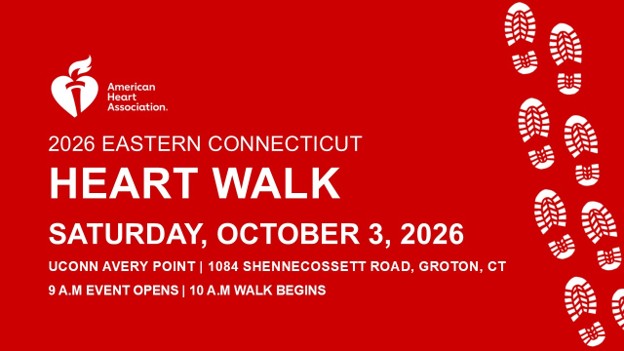
One Week Left—Let’s Claim the Torch! AHA Eastern Connecticut Heart Walk: Final Countdown
We are just one week away from the 2026 AHA Eastern Connecticut Heart Walk on October 3, 2026, at UConn Avery Point and this is our moment to finish strong. We’ve built incredible momentum, and now we’re within striking distance of something big. Right now, Electric Boat is holding second place, behind Mohegan Sun by...Continue reading→
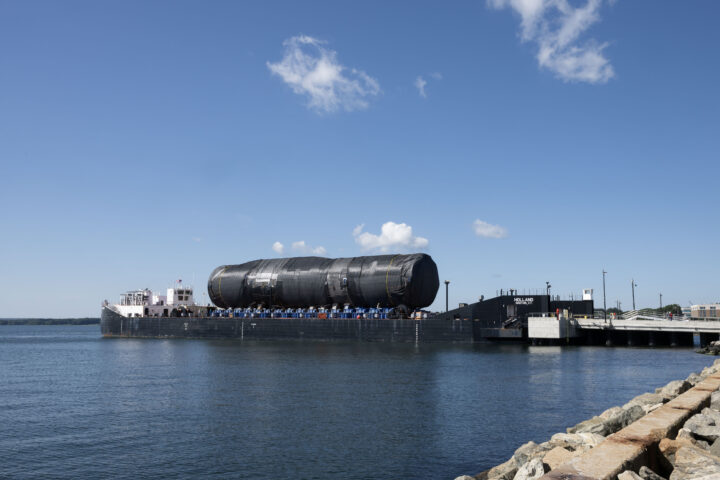
803 Section 2B/5 Transported from Quonset Point to Groton
PCU Arizona’s (SSGN 803) Section 2B/5 was successfully delivered to Groton from Quonset Point. At 184 feet in length, this section – which includes the Virginia Payload Module (VPM) – is the largest Virginia-class shipment ever transported. Arizona, the first submarine to incorporate VPM, will be about 460 feet long upon final construction. Section 2B/5...Continue reading→

Remembering September 11
On September 11, 2001, the Twin Towers of downtown Manhattan’s World Trade Center and the Pentagon in Washington, D.C., were targeted in a series of coordinated attacks that would leave an everlasting imprint on our country’s psyche. As the events unfolded on that Tuesday morning, nearly 3,000 people lost their lives, over 600 were injured...Continue reading→
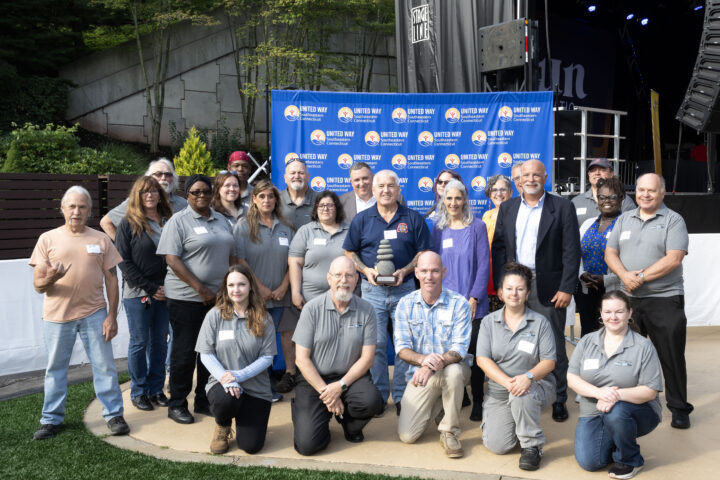
EBECSA Celebrates 75 Years — Nominate EB Employees Past and Present for Recognition
This year, the Electric Boat Employees’ Community Services Association (EBECSA) proudly celebrates its 75th anniversary. EBECSA was founded in 1951 by EB employees who wanted to create a dedicated, organized way to support nonprofit health and human service agencies in the communities where we live and work. What began as a small employee‑driven effort has...Continue reading→
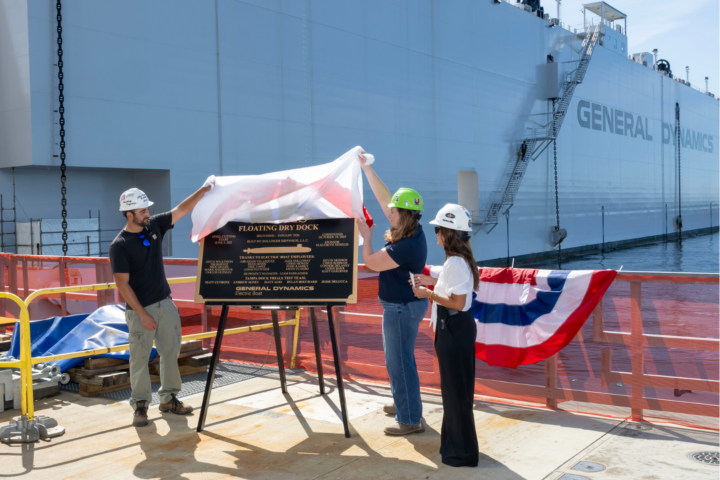
Atlas Plaque Unveiled, Honoring Plank Owners at South Yard Ceremony
Employees who have worked on Atlas, EB’s new state-of-the-art floating dry dock, gathered in the South Yard on Wednesday, Aug. 26, to unveil a new bronze plaque recognizing the contributions of its plank owners. The event celebrated the teams who helped bring Atlas from Bollinger Shipyards in Louisiana to its arrival in Groton earlier this year. Atlas will play...Continue reading→
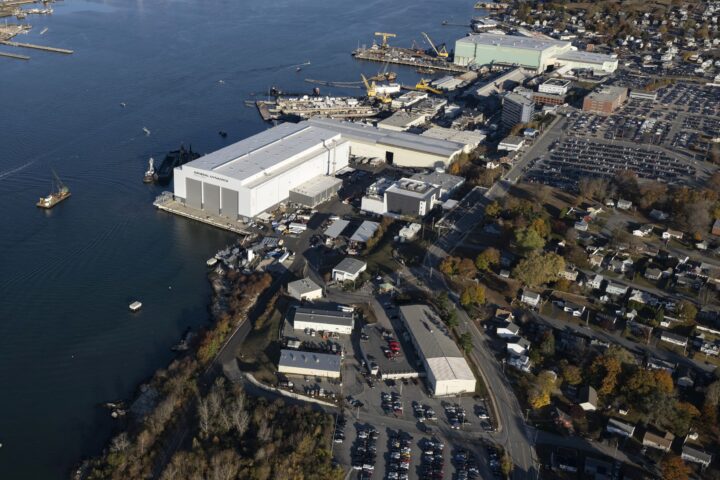
Neighbors Meet with EB to Discuss Noise, Lighting and Other Quality of Life Topics
Nearly twenty neighbors of Electric Boat’s Groton shipyard joined company leaders Aug. 25 for a community conversation focused on their quality‑of‑life concerns related to the South Yard Assembly Building (SYAB) and Atlas, the new floating dry dock. The Mayor of the City of Groton, Jill Rusk, also attended. Residents said they appreciated the chance to talk...Continue reading→
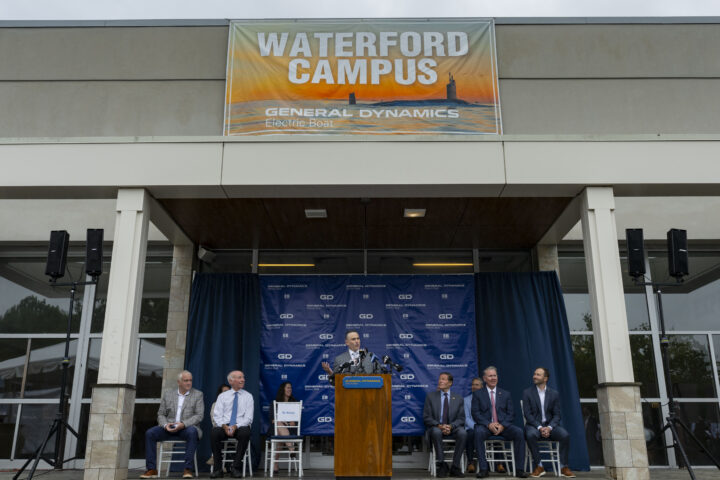
Rayha Report Ep. 26: Waterford Campus Groundbreaking
EB President Mark Rayha reports from the groundbreaking of the new Waterford Campus, where innovation, engineering and workforce development will come together to support our mission. The new facility will help train hundreds of shipbuilders daily as EB continues to grow for future production demands.
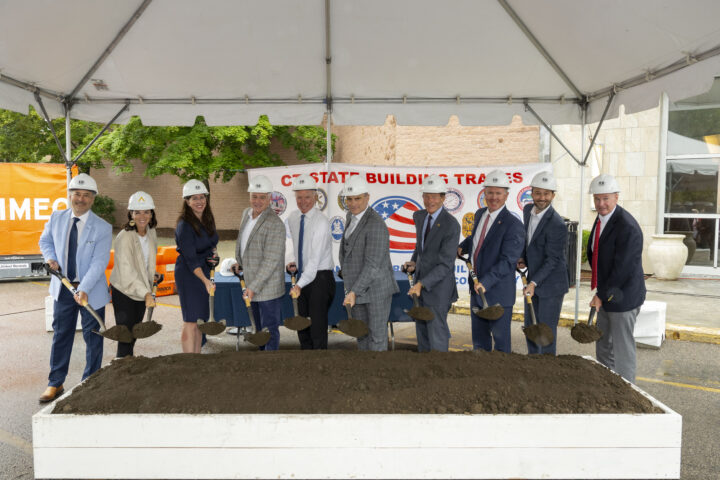
Waterford Campus Groundbreaking Marks EB’s Next Step in Innovation and Workforce Growth
Electric Boat officially broke ground Friday on the Waterford Campus, launching the transformation of the former Crystal Mall into a center for innovation, engineering and high‑tech workforce development. EB President Mark Rayha underscored how the project will reshape the way the company designs, tests and builds submarines. Innovation is the key, he said. “There’s an opportunity to...Continue reading→
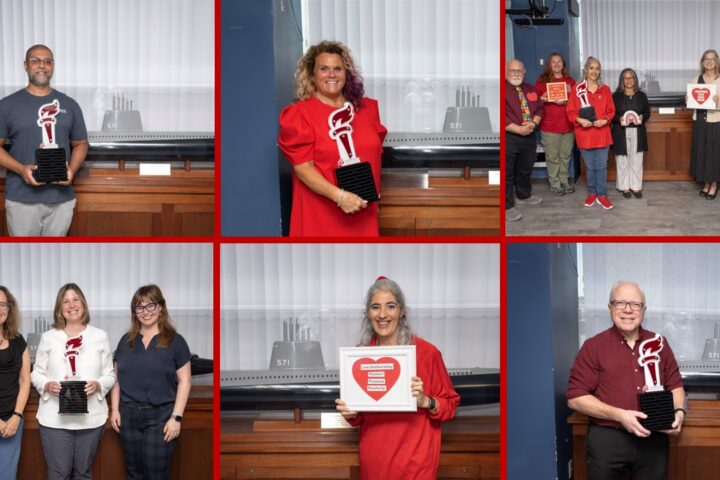
Powering HeartStrong 50: Thank You, EB Teams—Let’s Keep the Momentum Going!
Thank you to our incredible EB Heart Walk teams, our community partners, and everyone who joined the American Heart Association (AHA) Torch Journey photoshoot. Your enthusiasm and dedication made this milestone truly special. Now let’s keep our HeartStrong 50 energy going—our goal is 50 teams and $50,000 raised for the 2026 AHA Eastern Connecticut Heart Walk on October 3 at UConn Avery...Continue reading→
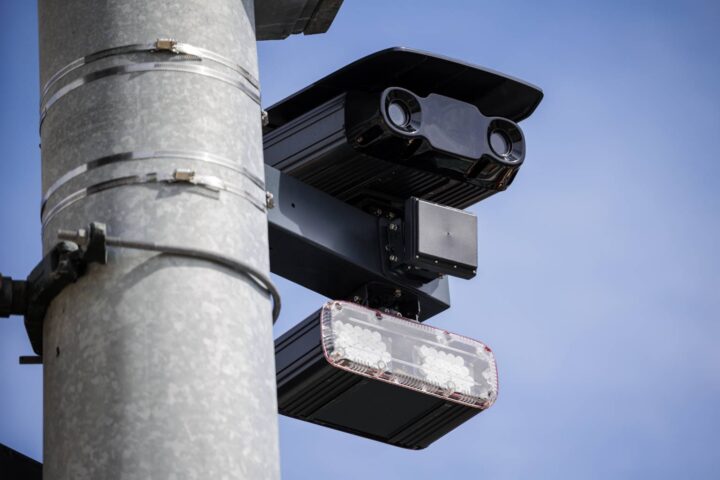
Speed Cameras to be Installed in the City of Groton
The City of Groton Police Department announced that automated speed enforcement cameras will be installed at several locations throughout the city. The cameras will be installed after the required 30-day public notification period, which began on Aug. 7, 2026. Camera locations: Mitchell Street Thames Street Clarence B. Sharp Highway (Route 349) Police said the purpose...Continue reading→