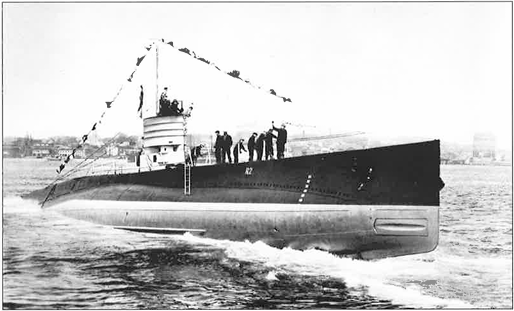
The first submarine ever built in Electric Boat’s Groton shipyard slid gracefully from its ways into the Thames River 100 years ago, taking to the water with “scarcely a splash” before a crowd of 1,500, according to newspaper accounts at the time.
A century after the 800-ton, 200-foot-long R2 was launched, EB shipbuilders continue to push the bounds of innovation. Their latest: a 20,810-ton, 560-foot-long colossus that will be called the USS District of Columbia (SSBN 826) when the first-in-class, nuclear-powered, ballistic-missile submarine is delivered to the U.S. Navy in 2028.
Electric Boat has come a long way since the R2 was handed over to Peruvian naval officers on July 26, 1926, marking the first submarine designed and built in Groton by EB subsidiary New London Ship and Engine Co. Previously, EB-designed boats were built by other companies, like Fore River Ship and Engine Co. in Quincy, Massachusetts.
A few comparisons are in order:
- R2 was powered by a pair of six-cylinder diesel engines. Columbia has a life-of-ship nuclear reactor with an electric-drive propulsion system.
- R2’s top speed was about 10 knots. It could dive more than 200 feet. Columbia will cruise at 20-plus knots and dive more than 800 feet deep.
- R2 was armed with four torpedo tubes and a .50-caliber gun mounted on its forward deck. Columbia has 16 launch tubes equipped with Trident II D5 submarine-launched ballistic missiles.
- Peru paid EB $1,218,000 for the R2 in 1926. In addition, Peru paid EB an additional $260,000 for torpedoes and accessory items, as well as $400,000 to construct a sub base in that country. The entire contract was valued at $3.1 million, about $58.5 million today.
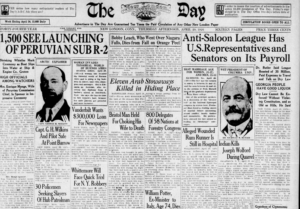
The R2 was launched April 29, 1926. Subsequent sea trials off Cape Cod were deemed a success. “The submarine remained submerged on the sea bottom at a depth of 223 feet for half an hour,” the Associated Press reported. Early engine trouble forced a return to Groton, but the R2 eventually arrived safely at its base – on San Lorenzo Island in the Pacific — in December of that year after an uneventful 3,350-mile voyage.
According to a contemporaneous report in The (New London) Day, the officers and crew of the R2 were “most enthusiastic” over the performance and reliability of its “propelling machinery, which operated perfectly throughout the entire voyage.”
The R2 was more than our first Groton‑built submarine—it was a declaration of what Electric Boat could achieve. A century later, its spirit of innovation is alive and well as our shipbuilders and engineers deliver the most technologically advanced submarines in the world.
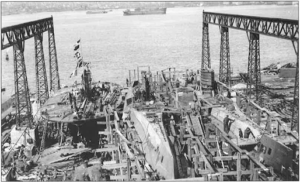
R1 and R2 under construction in the Groton shipyard. The ferry Elmer W. Jones is at left.