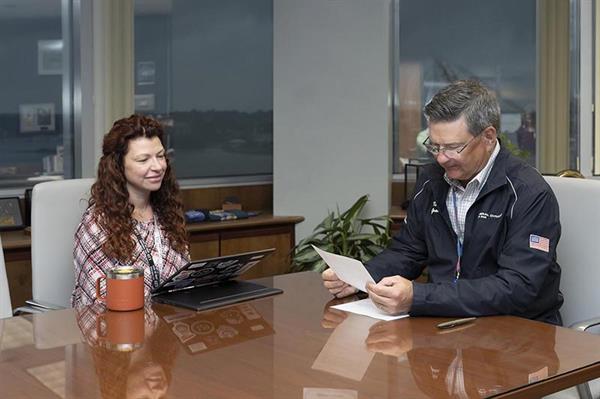
Hi everyone; it’s Kevin. Today is Monday, September 18. Throughout our 124-year history, EB has been the innovator in bringing the safest and most capable submarines to the United States Navy with innovations that include things like nuclear power, VPM today more modernly and electric drive propulsion for Columbia. Given the nature of our business, we’ve got a culture of not talking about how we do what we do. That said, we’ve got a lot of innovations we can be proud of, some of which we can talk about freely. Today we’ll talk about one example, EB’s Digital Enterprise, which up until recently, we called the “IPDE” or Integrated Product Development Environment. Joining me is Tabitha Hitchcock, EB’s Digital Enterprise Director.
So Tabitha, welcome to the podcast. Let’s talk a little bit about you first.
Thank you Kevin. I’ll be celebrating 30 years at Electric Boat in January. I’ve really been fortunate to experience very different, but related areas of the company in my 30 years including Structural Engineering, IT, Process Improvement, I spent two and a half years in the shipyard as an area superintendent for Hotel Services for the 777 and 779 PSAs, which was actually one of my favorite things in my career. Then 13 years ago now I took a position as a Principal Program Rep in the Columbia Program Office which really became the start of the Digital Transformation Program Office.
We talked a little bit about this before we started recording. That was a two-year assignment that’s now grown into 13 years into this role.
I get asked a lot when IPDE is going to be “done.” The answer is never!
Let’s talk about that. From my perspective, I came into EB in 1995, and we were in the middle of designing Virginia on a new system, in that case it was Catia. But really functioning in a 2D, document-based environment. So while we had a CAD capability to put the ship design together, it really got translated into 2D products. So now we’ve transitioned to a 3D, digital-based environment that started back in 2010, in what we’ve used for Columbia and now VPM, really well ahead of our industry counterparts, which reflects a commitment to innovation that’s part of our culture. Let’s talk about the context for why we started our digital transformation then.
In 2010, design for the new Columbia-class submarine was starting, and at the same time, our legacy design tools were reaching their end of life. Electric Boat recognized the limitations with our 2D documents and processes, and we saw some really new promising capabilities coming out in the industry that supported our ability to produce a single source of data, or what we refer to as a 3D product model, to feed our downstream processes.
Model-based design was really the direction the manufacturing industry as a whole was moving. We recognized that how we’ve always done business really would not enable the velocity that the customer needed for their ever-increasing national security demands. We did recognize that if we were going to do better and position ourselves for growth, we had to adopt the new way of thinking that the new technology enabled.
Additionally, it really hit us that our future shipbuilders were going to expect a way more tech-savvy environment than what we’ve had; essentially, they’re being born with a with a smart phone or tablet in their hand.
One of the things to point out here is being a pioneer, particularly in this field, and I believe we were one of the first in our industry to really move in that direction, is never easy. So let’s talk about how we got our start here.
That is 100% correct. As I mentioned, in 2010, I took a position as a Principal Program Rep in the new Columbia Program Office. I was given this assignment, which seemed really daunting at the time, and it was essentially “get rid of 2D drawings.” I wasn’t handed a team; I wasn’t handed a plan; it was just an assignment. Even my job didn’t really have a description; I had to write my own job assignment, so it was pretty interesting. That assignment grew and evolved, to us fully leveraging the model-based technology across the entire submarine enterprise. That means using a 3D product model from concept design through planning, construction and even submarine maintenance. So we implemented Siemens Model Based CAD and Product Life-cycle Management (PLM) Toolset, NX and Teamcenter to replace our legacy tools.
And we’ve evolved now from using 2D drawings that were, like you said, initially based off of a CAD model into 3D product-model disclosures, which means now there is one single source of data that flows throughout the enterprise that’s really our source of truth for our technical data. One other thing I wanted to point out, you mentioned about being early adopters, I think that’s what people forget. We were early adopters, and it was extremely difficult to have this huge culture and process change. I think that people sometimes suffer through and remember the trauma, and I don’t think that they recognize all of the good things we were able to do over the last 13 years.
Absolutely; I think that’s true. Now here we are, 13 years later, and we’ve re-branded from IPDE, where we began, to the Digital Enterprise, which is a different way to talk about this. Let’s talk about that change and why we’ve gone from IPDE to Digital Enterprise.
When we started, there was no definition or terminology for what we were doing, so, as we always do, we created our own EB-isms and terminology for our digital evolution. We were the guinea pigs for our software vendor; the software they were creating was really promising but it was still evolving; it wasn’t mature at the time.
Industry-wide nomenclature and definitions emerged in about the 2017 timeframe, but we stuck with our EB language, as we usually do. The manufacturing industry slowly started evolving to the new terminology, but we stuck with our EB language. It wasn’t until we noticed that we weren’t getting credit from our customers or even the industry…so we’d go to conferences and we’d see other people up there doing probably half of what we implemented, and they were being recognized as the industry leaders, and we weren’t. That’s when we noticed that words really do matter, so that’s why we’ve rebranded from IPDE to Digital Enterprise, and we’re really trying to adopt all of the terminology that goes along with it.
To your point, this isn’t just a name change for marketing sake. We’ve really come to a pivotal stage in our development of this technology in terms of a Digital Enterprise. We’ve gone from design, now to using that tool on the deckplate, and there’s a considerable effort and a lot of focus and resources moving towards improving things like planning tools, which is the natural extension of the design product moving toward the deckplate, adoption of digital tools on the deckplate—tablets and those kind of things—and then more processes throughout EB, and new manufacturing technologies today to increase volume and velocity for both the Virginia and Columbia programs, but also for all our future programs. So perfecting this and getting this Digital Enterprise moving in the same direction and becoming more and more efficient over time is really a lot of the work you’re involved with right now. So the rebranding really reflects Electric Boat’s ongoing commitment to our innovation. This is here to stay, and we’ve got to find a way to continually improve and perfect this process. I think those words do matter and help to strengthen our competitive posture for future work. So let’s talk about the next step—where does this go out in the future?
I’m actually glad that you said this isn’t going away, because as you mentioned before, this was supposed to be a two-year assignment, and everyone asks “when is IPDE going to be done”? and I say never. It’s true; we have to continually evolve. Now that we’ve gone digital, it’s even more important for us to continually evolve and improve. I think this is a really exciting time for us.
As you mentioned, our next priority is adoption and use of digital execution tools, such as tablets, on the shop floor and on the deckplate with now an exponentially larger workforce. This is the key enabler to support the increased rate of production we need to meet the Navy’s demands. Also, we may lead the shipbuilding industry in our digital implementation, but I think we do need to rethink our supporting organizational structure. We seem to lag the industry in the way we’re organizationally set up to support the next phases of our digital transformation for both our new submarine programs and manufacturing.
Yeah, we talked a little bit about that before we started recording; we said maybe less of a project or program-oriented Digital Enterprise and more of a global-focused organizational structure. So something for us to consider going forward.
From a capability perspective, we’ve been pursuing a lot of new capabilities that we’re expecting to roll out that are going to increase velocity. Some of those include:
- Digital data transfer of our technical data from Electric Boat to other shipyards, suppliers and our Navy customers. So now the Navy has access to our digital data, but we’re not really pushing any digital data to the Navy maintainers.
- Completing and improving Wi-Fi rollout at our shipyard. We’ve gotten a lot of that rolled out already, but we do need to improve it in certain areas where we have a lot of machines and equipment.
- I think one of the coolest things is augmented and virtual reality on the deckplates for installation and training.
- Network-connected manufacturing machines for performance monitoring and predictive maintenance for the machines.
- Robots and cobots (robot helpers for humans) for more labor-intensive manufacturing activities like welding, blasting and painting, just to name a few.
We’re seeing some of that already today at Quonset. Thanks Tabitha, really appreciate the story regarding our IPDE, and you sharing that with us, now known as our Digital Enterprise, and how we’ve become a leader in the defense industry in terms of digital transformation. This time in our history—really across all industries—is a time when digital technologies and advancements are driving business changes in ways we’ve never experienced before. The use of digital tools, especially in our shipyard, is key to EB achieving and sustaining the volume and velocity—you’ve heard me talk about that quite a bit. We need to support the Navy and our country’s security demands through our embracing of our digital transformation.
Thanks everyone; we’ll talk again soon.