Hi everyone; it’s Kevin. Today is Thursday, July 20 (date recorded). We’ve talked several times before on the podcast about our need to hire new shipbuilders. That’s going on like gangbusters. Over the next ten years, we’re going to be hiring about 20,000 more employees to keep our ranks at the steady state we need to deliver one Columbia and two Virginia-class submarines per year. By the way, I think there’s even more potential to do more than just two Virginia-class submarines if you guys are following the news about AUKUS and the demand for submarines in Australia.
Our talent-acquisition team members are going out to regional schools, including high schools, elementary schools, we’re talking to parents and guidance counselors, we’re at career and technical schools to spread the word that designing, building and maintaining submarines is a rewarding and life-changing career. I can certainly attest to that. It has been a very fulfilling career for me and life-altering for me and my family as well. And I know many of you listening feel the same. One of the most powerful ways that we can help students understand this is by having them speak directly with experienced shipbuilders, one on one. It tends to break down those barriers and gets people interested in a job in shipbuilding.
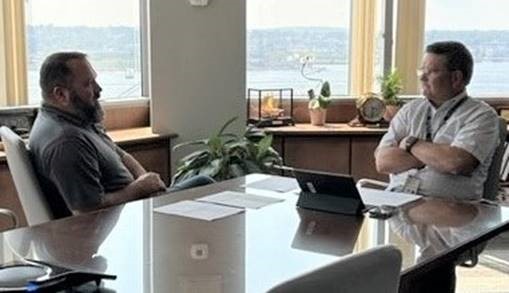
So today I’m joined by one of our shipbuilders, Jim Arpin. Last fall, with his management’s approval, he started sharing his story as what we’re referring to as an EB Ambassador. Based on feedback from students and guidance counselors, his conversations with students have really made a difference. We’re starting to see some real traction, particularly in the high schools. Potential recruits can better relate and then picture themselves working at EB when they speak with someone who shares a similar background, skills and career path. I know a lot of this is happening naturally. Many of our folk are talking to their family members and people in the community just informally on an ad-hoc basis. So the ambassador program is now expanding, and we’re looking for more shipbuilders, we’ve got a number of volunteers already from across all the employee groups at EB, to volunteer as ambassadors.
So today we’re going to talk a little more about that. Jim, welcome to the podcast. Let’s talk a little bit about your background at EB.
Thanks Kevin. I just hit my 15-year anniversary.
Congrats!
Thank you very much. Started here in 2008 at Quonset Point as a shipfitter, shortly thereafter I became a supervisor, worked my way up into the nuclear ranks and became a nuclear structural lead on a few modules there in Quonset Point. Transitioned here to Groton as a general foreman on third shift, so I had all trades on third shift. Then worked my way into the pipe shop where I now oversee PSA and overhaul and repair for the piping trades.
That’s a great background and a typical story. When we talk to our young people we talk about “hey this isn’t just a job, this is a career.” I think what we sometimes don’t do very well is point out to people how quickly you can grow in this business. Somebody such as yourself started as a shipfitter, and now is a boss in the yard as a general foreman—that’s quite an improvement in your rank in the company and, certainly, benefits you and your family.
Thanks for that background. Let’s talk a little bit about what it’s like to be an ambassador—what you do, what kind of events you attend, and tell me a little bit about some of the interactions you’ve had.
Over the past few months I’ve been to a lot of different events: career fairs, hiring events, high-schools, technical high schools, sporting events, I’ve been to the Yard Goats, I’ve seen the UConn hockey team; even gone out to the NCAA Big East Tournament in New York to spread the work about EB and what we are and what we’re about. Been doing this for the company now since last September. I’ve gone all the way from Groton to Danbury within the state to different fairs and different schools. I’ve seen probably 60 different venues and thousands of different people and had the opportunity to spread the world. HR has been with me every step of the way. I think this year they’re going to be going to something like 600 events; they’ve already hit about 400. So you can imagine how busy everybody has been. With numbers like that, you can honestly see why we need more people to do what I’ve been doing with the company since September.
So tell me what the interactions are like when you talk to people. I imagine some of this is just explaining what EB is about. A lot of people don’t know. Tell me a little bit about the feedback you get from the folks you talk to.
It changes depending on where you are. The closer we are, obviously, the more people know about who we are and what we do. A lot of times they have family that’s worked here, multi-generation families that have been working here, so it’s very easy to talk to them. The pride is already there for what they understand about what we do. But the further we get away within the state or across state lines, you start seeing people who have no idea what we do, so we really have to inject our experiences, the pride of what we do, what it means to us, and what it means to our country about what we do. We start giving them some information and it really opens their eyes about who we are as a company.
What are some of the common misconceptions in terms of educational background and stuff like that that you see?
I can tell you a lot of people think they need to be highly educated or have some superior technical skills or background to start working here. When I can explain to them that we’ll teach them and we’ll use our own schools that we’ve developed, and tell the high-school students that as juniors they can really just start keying in on certain courses or certain ideas/things to think about and learn, so they can come out of high school and start with us right away as a high school graduate.
I agree with that because I run into young people from time to time and we talk about that. I think unfortunately in our society today there’s this sense that you’ve got to go get a college education and be in debt six figures before you’re going to get a viable career. Absolutely not the case. I think our young people need to know there are great opportunities coming out of high school to come here and work in the shipyard. They can get educated and get that higher degree if they want to do it after they’ve worked for a little bit. For me, it’s always rewarding to see the interest and excitement in people’s faces. I think generally speaking, EB shipbuilders love to talk about what we do; tell me a little bit about what it’s meant to you. How do you feel about being an ambassador?
I really love going out and talking specifically to high school students and most recently even middle school students about the years I’ve spent here, the 20-some-odd boats I’ve had the opportunity to work on, the experiences, the people that I’ve worked with and the pride to watch these things go down the river when they’re done. It really shines through because it means a lot to me—the years I’ve put in, the different boats and the different people that I’ve worked with, it really shines through and the kids see that and they feel that. It makes them more interested because I’m interested. I think that has a lot to do with that. They really don’t know what we do, like I said especially as you get further away. You start telling the kids about the college reimbursement, things like, hey, you don’t need to be at the top of your class to work with us. We’ll teach you everything you need to know and give you all the skills you need. All you need is a little bit of work ethic and you can come here and make yourself a really good career.
Absolutely true. Some people listening may be interested and wonder if they’re cut out to be an ambassador. What do you think some of the attributes of a good ambassador are?
You just have to have a great attitude about what we do, be able to spread the word and really let that pride show through. It’s not a huge commitment; realistically, an ambassador can spend as little as two to six hours a month and really make a difference. Typically, the average college fair is maybe two hours; job fairs are about two, two and a half hours. It’s not a huge commitment, but it really can make a difference. I’ve gone to multiple schools now where I have the administrators asking to have me come back because they appreciate the effort I put into it and the information I’m giving to their students. It makes me feel good too.
I think it makes a big difference. Decades past, we’d put an ad in the paper and people would come to EB. Today we can’t do that; we’re in a tough competition for people all over. So when we can get out into the community and put a face on Electric Boat like yours it starts to break down those barriers. What we’re seeing is people applying for jobs from non-traditional sources. We’re making some steady progress. I think it’s an important opportunity for us to take advantage of.
So Jim I want to say thanks. Appreciate everything you’re doing for Electric Boat and especially today for joining me and sharing your experience. So those of you out there who are passionate about what you do here at EB—like I am, and I know that’s many of you—if you’re outgoing, and able to work it out with your leadership, please consider becoming an EB ambassador. Recruiting and hiring is not just a job for HR. I know many of you talk with your family, extended family and friends about what you do at EB. With the hiring need we have in front of us, it takes everyone doing their part to reach our goal. So if you can share your knowledge of EB, your experiences and the importance of your work, we’ll include a link in the transcript to reach out to our talent-acquisition team.
Everyone thanks for listening; we’ll talk again soon.