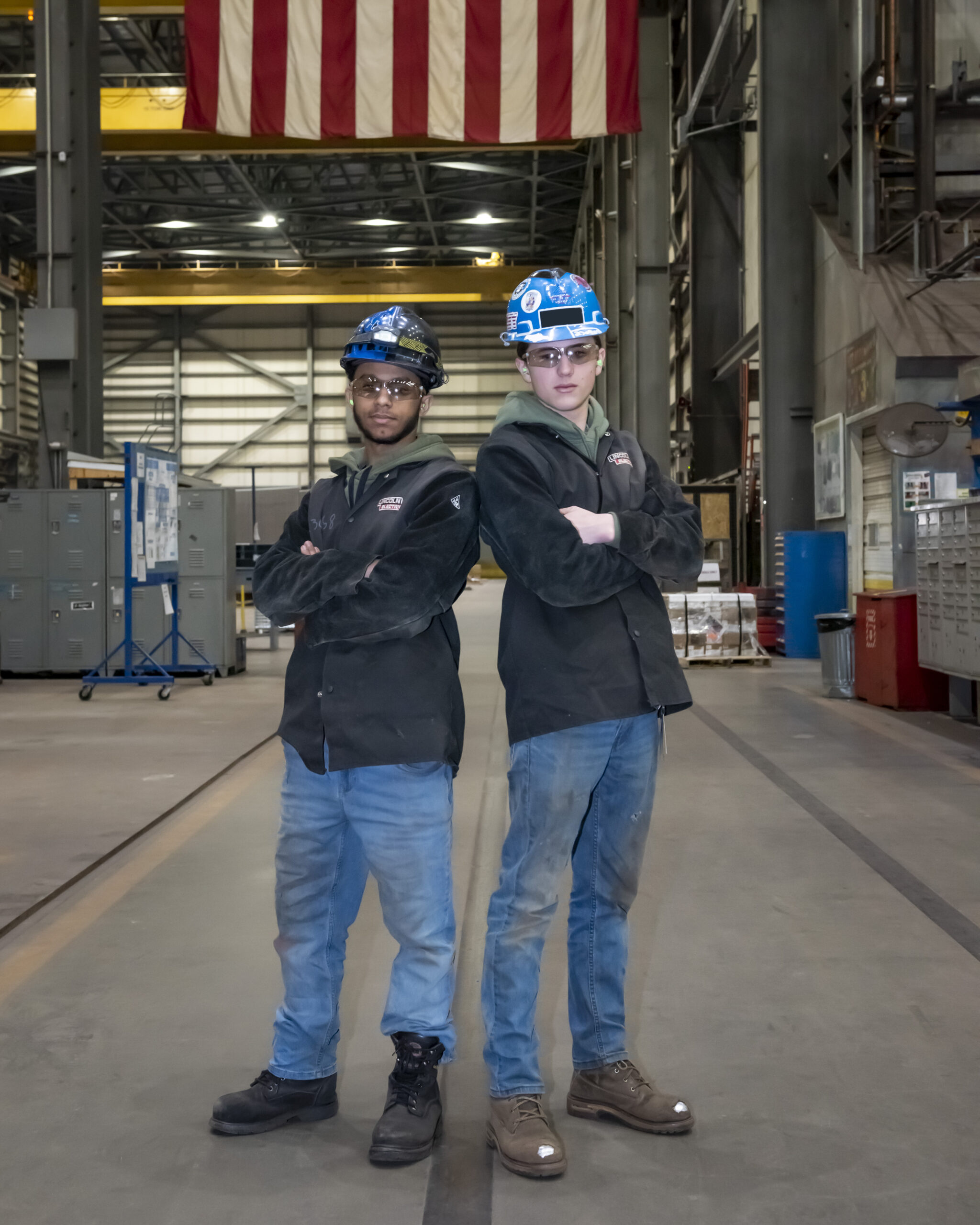
L – R: Co-Op students Jayden Solano and Dom Fiocchi
KG: Hi everyone; it’s Kevin. Today is Friday, February 24 (date recorded). As you know, we’ve got an opportunity to deliver submarines that has never been higher in our history, and it comes with a significant and really persistent need to hire new shipbuilders for the foreseeable future. We’re using every opportunity to find them and bring them into our facility. Over the next ten years, we will hire about 20,000 more employees to keep our ranks at the steady state we need to be which is somewhere north of about 20,000 people overall on a daily basis. Most of these new employees will be in the trades and engineering.
To meet this goal, we’re doing a lot of things; one of the things we’re doing is reaching out to our regional schools at all levels including elementary and high-school levels to make sure students, guidance counselors and parents know what we know—that designing, building and maintaining our nation’s submarines is rewarding and a life-changing career. We’re also working with high schools, career and technical schools and other colleges to develop internships and customized curriculum so when someone graduates, they’re qualified to work at Electric Boat, and in some cases, have a job in hand before they graduate.
Today on the podcast I’m joined by two members of our workforce development team—Nancy Martin and Willie Barber—to talk about training programs focused on our young people in the community. I’m also joined by two high-school seniors from Coventry High School’s Regional Career and Technical Center—Dom Fiocchi and Jayden Solano—to talk about their experience working as welders at our Quonset Point facility two days a week as part of our Co-Op program. So welcome everyone. Nancy, let’s get started with some background on our pipeline programs.
NM: Thank you Kevin.
Over the past ten years, the Workforce Development team has been helping to grow the workforce very strategically through partnerships with state agencies such as the Eastern Connecticut Workforce Investment Board (EWIB); the Southeastern New England Defense Industry Alliance (SENEDIA); the Connecticut Department of Economic and Community Development (CT DECD) and the Rhode Island Department of Labor and Training (RI DLT). These relationships have allowed us to educate youth and adults about EB’s career offerings in both Connecticut and Rhode Island.
As you know, we have adult pipeline programs that train trade and support occupations so participants are production-ready shortly after coming in the door. We started out with only a few programs initially and have now grown to partnering with six educational partners; five are local—New England Institute of Technology, Community College of Rhode Island at the Westerly Education Center, Three Rivers Community College, Thielsch Engineering, Quinebaug Valley Community College—and one is in South Carolina—Trident Community College. With the help of our internal partners, including the Talent Acquisition organization, the Curriculum Development team and subject-matter experts, as well as EWIB, SENEDIA and RI DLT, we have put roughly more than 5,000 employees through our training pipelines since 2016.
KG: These pipeline programs have given us a tremendous advantage in hiring. What maybe some of the listeners don’t know is how special these really are. When I talk to my counterpart at Newport News, they don’t have anything like this; this is really unique to the New England region. We have been doing this now at scale for quite a few years and bringing in some very well-qualified folks. Those other shipyards around the country, including some Navy shipyards, are absolutely struggling because they don’t have the partnerships that we’ve got. We’re lucky to have that and lucky to have commitment across our broader community in the state and local governments as well as some of the federal dollars we’re seeing to get to a better solution than what we’re seeing across the country. So this relationship is really win/win—it builds up manufacturing skills throughout Connecticut and Rhode Island that our suppliers and other manufacturers can also benefit from.
Let’s talk about what we’re doing in the schools to introduce young people to manufacturing careers.
NM: In our high school partnership programs, we had two goals:
KG: I learned this recently; it’s pretty interesting, and I don’t think most people realize just how competitive it is to get into career and technical education high schools these days. I think that’s wrong; I think it should be easier, not harder, so it’s important that we spark that interest and enable young people particularly, who may not know about a career in manufacturing, to be able to get into some of these technical education opportunities.
NM: Absolutely. Our program Boat for Next Gen is for those students. The program enables high-school students to experience our six core trades by having them visit our offsite training locations, such as the Westerly Education Center, to actually do hands-on trade activities.
For the CTE program, we brought all of the needed partners together, assessed the landscape of both states’ programs, and one-by-one, helped build out their programs. This might sound like an easy feat but it definitely was not. With the states backing us, we had enough momentum to establish the maritime manufacturing curriculum into state standards, identified the schools who has the infrastructure to house a program and then helped implement the new programs. Over the past seven years, we have partnered with 19 schools, and we have 30 partner programs that support maritime manufacturing with six more under development. These programs range from welding and machining to design.
KG: That’s great, thanks Nancy. Willie, let’s talk about how we work with the CTE schools, and in particular, the Liaison Program.
WB: Thanks Kevin. Some of the resources we provide to the schools range from info sessions about EB, curriculum development, application workshops and the Liaison Program that you’re referring to. In that program, a graduate from a specific CTE program who now works at Electric Boat goes back to their high school to mentor students bi-weekly. We chose this concept so students can easily see themselves in that mentor’s shoes in the future.
EB also provides summer internships with our partner programs. Workforce Development and Staffing work together to provide this opportunity and, in Groton, the Summer High School Internship Program (SHIP) is supported by our union partners who really help students to experience life as an EB employee.
This past summer we had 40 SHIP students across Groton and Quonset Point, with nine of them as welding interns at the Quonset Point facility. Over the summer, they received several welding qualifications during their eight-week internship. This then transitions into the Co-Op program where they work right on the deck plate one-to-two days per week during the academic year at Quonset Point. Two of our Co-Op employees are sitting with us here today.
Thanks Willie. So I got a chance to meet Jayden and Dom briefly before we started recording the podcast today, so I want to talk a little bit about your experience. So you guys have been friends for a while…how far back does your friendship go?
Dom/Jayden—about six years.
So you guys knew each other when you were middle schoolers—that’s awesome. So what got you guys excited in welding?
Dom – what started it off for me was in middle school, I remember my high school actually came down and they were showing us classes to sign up for, they brought in a virtual welder. We got to practice on that and I got interested in it. Once I got into high school, I actually started welding, and I enjoyed it and I got better at it.
It wasn’t until about junior year that I actually started picking up on things and getting the hang of it and figuring out how to do it better, with different tricks. I always had an interest in it because my brother welded when I was younger, but I hadn’t tried it until I got older.
KG—Jayden, how about you?
Jayden—I like working with my hands with my Dad. We would build stuff. When we went to the middle school like Dom said with the virtual welder, I liked it at first. But when I got started welding, it was a whole new experience for me which I really loved.
KG—since you’ve been here as Co-Ops, what have you been able to work on?
Dom—we got to work on the foundation for the AC units. We’ve worked a lot on the decks. Right now I’m working on a foundation. My boss put me on my own small project, a foundation. They’re always decently long projects that keep us busy.
Jayden—I’m literally across from someone, it’s called a wing; there are 20 joints: overhead, vertical, flats, a lot! It keeps me busy, which I really like.
KG—so you get a chance to go back to school and talk to your friends. What do they think about all this?
Dom—I like talking to the younger guys in my old welding class who are trying to get here next year. They like to hear about my experience over the summer time, how the class was, how difficult it was. It’s cool to see younger kids who want to come out and do this too.
KG—some of the EB guys are pretty old, pretty grizzled shipbuilders, they can be pretty scary though. Some are me-old, I suppose. How have they treated you?
Dom—Awesome, they’re all really friendly, funny, easy to get along with.
Jayden—If I got stuck on something, I would ask and they would just show us. They are so friendly about it.
Dom—they’re very willing to show us. They like the fact that we’re asking questions and trying to learn and get better at it. They have no problem showing us, how to direct us on a straight path on how to do everything the right way.
KG—So it sounds like we’re taking good care of you guys.
Thank you both. It’s actually very rewarding for me, and I mean that sincerely, to meet young people like you who really represent the future of our company. I need you guys to tell all your friends because we need them. So you guys haven’t filled out applications yet, but we’re going to get you to do that. You can do that right away Jayden, right because you’re 18. Dom, we’ve got to wait until March, but that’s only a month away.
We had a chance to test drive you and you guys got to test-drive us. I think it’s a good match. You’re going to have the opportunity to work on some of the most complex machines that we build in the world, and I think we build the best. You’ve got an opportunity right out of high school to join the best submarine and shipbuilders in the entire world.
I’d like to offer you guys, if there’s anything you need from this team, don’t be afraid to ask. Learn as much as you can. We need you. I’d like to remind folks that we also have a middle-school program, in fact, Dom and Jayden talked about that, Boat for Explorers, and an elementary school program, Boat for Kids. Getting that into the schools and working with our young people to get that interest sparked early is an important way we’re going to recruit our employees for the next couple of decades. We’ll provide links (educational programs and high school programs) in the podcast for folks who may be interested in those programs.
Thanks everyone; we’ll talk again soon.