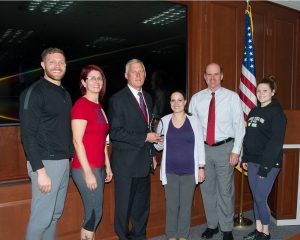
Clockwise from left, John Kimball, Megan Roberts, Kirk Scheel, Kevin Graney, Beth Benzle, Andy Fiore, Mitch Dias.
Hi everyone; it’s Kevin. Today is Wednesday, October 19th (date recorded). You’ve heard me talk about the four fundamentals of every shipyard, and that’s safety, quality, schedule and cost, in that order, and all of our yearly goals since I’ve been in the role I’m currently in reflect that, and the senior leadership team is on board with this as well. Today on the podcast I’m going to talk about a focus area where each and every employee has a responsibility; that is, process improvements. If we think about safety, quality, schedule and cost, often we talk about continuous improvement as number five of those key elements.
To ensure our first-time quality and increase our efficiency, we need to look at how we do our work and ask if there’s a better way or a better tool to getting the work done. And it needs to be a natural part of how we do business, which is where we’ll get to with practice. I want to make sure we understand there are 18,000 of us who come to work every day—we are all experts in something. I am not an expert in welding or NDT, but I know people who are. We’re going to talk a little bit about that today. The contributions we get from our experts across the organization are what today’s podcast is all about. We’ve asked each of you to submit two process improvement ideas as part of this year’s Employee Incentive Program.
With me today is Megan Roberts, our VP of Quality, who you know, and Kirk Scheel, our Director of Sub Material Engineering, along with two members of their team who’ll talk about some process improvements I’ve learned about recently that they’ve identified and put in place in their work areas.
So welcome everyone. Megan, let’s get started and talk a little bit about why process improvement is important.
Megan: Thanks Kevin, the team and I really appreciate the opportunity this afternoon to highlight some of the process improvement efforts that we’ve either been able to implement or are in the process of implementing and to talk about how important continuous improvement is to establishing a strong quality culture of culture at EB.
In the quality organization, one of our primary objectives is to ensure our products are delivered and satisfy the standards and requirements set by EB and our customers. This is only achieved through the help of every employee at Electric Boat ensuring their work is performed correctly and in accordance with training and applicable policies and procedures.
Continuous improvement is really finding opportunities to streamline those processes and policies and to reduce waste to improve performance across the organization. So in a lot of ways quality and continuous improvement go hand in hand, and they work best when every member of our team not only ensures they are completing their work correctly the first time, but also that they’re thinking critically about what they could do to make their jobs easier or make the jobs of their teammates easier and more efficient.
By doing this, we can ensure that we can continue to deliver high quality products and that we’re always continuously looking for ways to make things better for our workforce.
KG: One of the things that’s import for me from a continuous improvement process perspective is that it enables us to be faster with how we can do our work. If you think about the velocity of submarines coming through our shipyard and entering the fleet, it’s never been more important for us to put submarines out more quickly than we ever have. Our nation very desperately needs these boats, and we’re the only ones who can bring that to fruition. Thanks for that background. Kirk, let’s talk a little bit about the team you’ve got with us here today and let’s hear their process improvement stories.
Kirk: Thanks Kevin. We’re definitely excited to be here to share just a couple of stories out of many that we have irons in the fire on. We definitely understand the benefit we bring in welding NDT, robotics, non-metallics, can definitely achieve that velocity that you’re looking for.
First, I’d like to introduce Mitch Dias, he’s a non-destructive test, or “NDT,” Level III Examiner. Level III’s help certify NDT inspectors, they provide deckplate oversight, help maintain the procedures, and if there is something we want to change in the NDT program, they’re the guys to do it.
KG: I know a lot about Level III inspectors—you guys are like unicorns; you’re pretty rare individuals these days and absolutely critical to the submarine enterprise. Thanks for joining us today. Why don’t you describe what MT is and what the process improvement you’ve adopted is.
Mitch: Thank you very much for allowing me to be here.
- MT is a means for evaluating the surface quality of welds.
- In the process itself we use a yoke which induces a magnetic field into the part. We apply magnetic particles to the part, then remove them, and if there is a surface break in there, these particles collect in this leakage field, and it will identify the size and shape of the indication itself.
- Being able to identify these rejectable indications is necessary to ensure welds perform as expected in service.
- My process improvement idea was to evaluate the feasibility of using fluorescent MT powder and color contrast paint along with the conventional MT powder we use in our shipyards.
- I came up with this idea because in MT we have a lot of variables, including the positions inspectors have to get into, technique and lighting, among others, that make the job somewhat difficult. As an example, if you think about putting yourself in a confined space where you have poor ambient light and are doing an overhead inspection, it’s going to be very difficult to evaluate indications that you may find. With these fluorescent MT particles and color contrast paint, it seemed like tools that could help our inspectors to better see in these challenging environments while ensuring quality.
- I took the initiative to procure the materials I needed, and I began a small in-house study a couple months back to see if the commercial materials would work.
- Right now, the white contrast paint has been very promising. That’s going along the approval process right now. As far as the fluorescent particles, that’s still in development. I’m hoping to have the R&D study completed for that by the end of this year and implemented hopefully by the first quarter of next year. (Click here for comparison photos.)
KG: Let’s talk a little bit about that. The obvious thing we want to do is get this in the hands of the folks who can do some good work with it. How do you plan on rolling this out once you get a little bit further in your R&D?
Mitch: Once the R&D is done, I plan on starting very small. Most likely, isolating it to a single inspection department for right now. That’s a little easier to control. Get a couple of people trained and qualified in it. Provide some oversight with them on the floor, do the process with them for a couple of months and evaluate them and see how they are identifying indications and how they’re doing the method compared to someone who isn’t using the color contrast and just scale up from there.
KG: Great, and you think ultimately we’re going to be able to move a little bit faster or qualify people maybe a little more readily than we would otherwise?
Mitch: This process will definitely help in that, yes.
KG: Good, well that helps with velocity ultimately across the organization. Thanks.
Kirk: Thanks Mitch, that’s a great project you’re working on to bring another tool to the inspection department to help them out, the way you’re approaching it on making sure we do the right staff work to make sure it’s right before we hand it to the shipyard is the right standard. I think it’s going to provide a lot of benefit; appreciate it.
Next up is Andy Fiore, who is a Welding Engineering Manufacturing Rep in the Quonset Point Construction Support Team. For those who don’t know, welding engineering supports a whole host of partners from our vendor base to our engineering departments to primarily construction teams or the operations teams. Andy actually came from the operations team; he was an X-ray welder in the Columbia AFC including being a robotic technician to weld the quad packs, so he brings a huge amount of experience. He’s a support service to the Ops team to evaluate new equipment, new processes and help on day-to-day problem solving with welding problems.
KG: Andy, I came across you maybe a month ago or so when we were up touring the welding shop in Quonset. You took the time to show me some pretty neat stuff. Appreciate you coming down from Quonset to be here today. Let’s talk about the PI you showed me and what we’re doing with that in the E and F fixtures at QP.
Andy: Thanks Kevin, appreciate the opportunity to be here today.
- The initial bulk wire set up on these fixtures was essentially an oversized welding conduit with pneumatic air-driven rollers attached to 500 lb. weld drum wires; this wire fed the welders’ wire feeder. Due to the configurations in the welding evolutions of the fixtures, these feeders can be up to 40 feet away. These setups were prone to have poor and/or erratic wire feed, causing weld quality problems.
- I took the action to solve this problem after a hotwash between EB and BAE Systems earlier this year.
- In the meeting we learned that each facility had experienced the CMC Quad Pack construction issues with welding equipment—comparable build sequence, same equipment, overall same issues.
- BAE reps shared they had purchased a welding conduit with individual rollers integrated inside to fix this issue. It was explained that it was “plug and play,” easy to use, easy to maintain, there was no downtime to the equipment to stop operations, no major modifications needed to the existing welding equipment and it worked extremely well. The liner is robust enough to handle the intense model wire that goes through it, and the welders were able to run the 500 lb. drums effectively with no problems, and they’re able to produce an acceptable UT/RT weld.
- After this meeting, I spoke with B2019 supervision/management/facilities and the decision was made to purchase and install this roller welding conduit based on BAE’s welding success.
KG: So we employed that in the E and F fixtures in 2019; so how is that going?
Andy: We employed it on the F-fixture verticals, the 22-foot seams. The welders just finished that evolution a few weeks ago, and it was 100% accepted UT quality, and the welders reported back they had zero wire-feed issues and they had 100% confidence in it, with no concerns. They really like it. (Click here for photos of the roller welding conduit.
KG: You’ve done welding here; one of the biggest hassles we hear about is the welders needing to change the spools on the feeders on a regular basis. I would imagine 500 lbs. is a heck of a lot easier than repeatedly changing out 40 lb. spools, right?
- Correct, this enables the technicians to be loaded for wire to go do their jobs, so they are loaded once a week. They don’t have to go to the crib every single day to get their wire sheets and verifications; it’s all verified on the drum already.
- Each of these joints take 100’s and 100’s of pounds of wire—22 feet long, you’re talking several hundred pounds of wire. Now they don’t have to worry about changing wire, stops and starts, they can just continue to weld.
- With the reliability of these rollers, there are no external motors, no extra accessories needed to operate it, it runs off the wire feeder alone. If there is an issue, it’s very easy to disassemble and change a part and get them back to work.
KG: So you’ve picked this pilot in the E and F fixtures where we do a lot of welding. We do a lot of welding in the AFCs and even when we’re doing butt welds on hull module sections. Are there applications where we can use this type of an approach on those as well?
Andy: Yes, it’s being investigated currently by our team at Quonset. We’ve been talking with management to see where they can use this; specifically, air flask bottles, hull butts, areas where there’s a heavy amount of poundage of wire being deposited. There are adapters/accessories to make it versatile.
KG: What’s a good application here in Groton?
Andy: I would like to talk with Groton Operations, but I would say hull butts, but it depends on the equipment and how they do their wire delivery systems, but I’m sure we can figure out a way to adapt it if need be.
Hey, great opportunity for us and just another example about how process improvement is helping us go faster and improve our velocity across the organization. These are some great examples of what continuous improvement is about, so thanks Mitch and Andy. This is also, back to the beginning, we talked about how people who are closest to the work are truly the experts in this business and can really drive process improvements because you know best what’s going to make your job easier every day.
Everyone, if you haven’t done so yet, I’d like to remind you to submit your two process improvement ideas using the continuous improvement action database. What I’m hoping for is we get more participation from across the business, from all of our 18,000 experts, so we can go faster and deliver the submarines our country so desperately needs.
Thanks everyone; we’ll talk again soon.