Hi everyone, this is Kevin. It’s Thursday, September 24. Today on the podcast we’re continuing our theme on Operations that we started two weeks ago with Sean Davies focused on Quonset Point and how important it is to achieving our mission. Today I’m joined by one of Maine’s native sons, Jim Gildart, our Vice President of Operations for Groton.
Jim, welcome to the podcast. As I said to Sean, Operations is near and dear to my heart. Let’s focus on what’s happening in the Groton shipyard and several key areas we’re working on.
To get started, tell us a little bit about yourself.
I started here at Electric Boat in 1986; it probably took me until 1988 to get rid of my Maine accent. I began on the waterfront in the nuclear test organization, mostly working on Los Angeles-class ships and almost exclusively on the ways. I then transferred to the Kesselring Site in upstate New York for a good chunk of my career and wound up back here in 2007 in Groton Operations. I became the Vice President of Operations about ten years later. I’ve always thought that each position along the way was the best job in the company. That feeling hasn’t changed; I feel that way today. Being a part of the team who are the greatest submarine builders in the world has always been a source of pride and continues today, even more so.
Thanks Jim, that pride runs deep with me as well. When we think about our purpose and providing sailors with the ships they need to defend our nation, that is a very clear and compelling reason to get out of bed in the morning and come to work. Let’s talk a little bit about the projects that are underway in Groton and upcoming milestones.
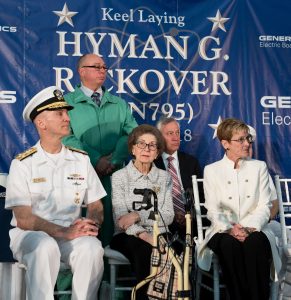
The shipyard is really busy right now. We are in the endgame on PCU Oregon, getting ready to launch the final test program there. We just achieved pressure hull complete on PCU Rickover, we’re close to Initial Fill on PCU Iowa and are making really good progress on the earlier ships PCU Idaho and PCU Utah. Meanwhile, in Graving Docks 1 and 2, we are working on USS South Dakota, doing upgrades, and repair work on USS Delaware. USS South Dakota will be floating off after the first of the year and USS Delaware is proceeding really well, ahead of schedule. When you take a step back, there are seven major construction projects going on right now in the shipyard, and that doesn’t include the important off-site work we have as well.
By any measure, there are many projects being worked successfully and simultaneously in the shipyard. This is important work that the Navy needs to keep our nation and sailors safe for now and many years in the future.
We really are busy. Let’s talk a little bit about maintenance and modernization. What do we have coming down the pike?
Right now we have a planning contract for the Hartford. The Hartford will be arriving here next summer and it will be a multi-year contract. This is a big contract; it will basically be the size and scale, for Groton’s effort anyway, of a Virginia new-construction boat. By the time we re-deliver her back to the Navy, we will have gone through the boat from one end to the other. It’s not only important for the work’s sake, it’s also important because it gives us two major programs for the shipyard to handle at the same time. That’s important to transition us from where we are today, which is predominantly a Virginia construction program, into two programs—the Hartford and Virginia—and ultimately move us to where we’re going: Columbia, overhaul and repair, and Virginia. That’s the transition we’re on, and we’re going to be on that transition for the next three years.
I agree with you on the importance of those multiple programs. That’s going to be the way of the future for us, and I think from a maintenance and modernization perspective, we provide a critical service to the Navy being able to repair in-service submarines, and we need to be able to flex that muscle from time to time in order to stay competent. Let’s talk a little bit about the investment going on in the shipyard. We spent a little bit of time with Joe Drake a few weeks back talking about the South Yard. Let’s talk about what that means to the Operations organization.
In the South Yard, we are basically building a whole new submarine construction facility. The significance is that it’s a once-in-a-lifetime opportunity to set up a major facility and upgrade our shipbuilding so we can accomplish that three-program cadence. It’s important for us now to not only focus on the facility but on our shipbuilding strengths, so we have enough skills, enough people and enough supervision to handle that challenge.
If you were to break down the shipbuilding fundamentals, what are your focus areas—what are you pushing with your people to make sure we’re paying particular attention to and why?
First things first, we have to focus on being safe. Everyone should come to work and be able to go home the way they arrived. That comes first. Secondarily, doing first-time quality work and getting that first-time quality work done on time. It comes through continuing to focus on getting better every day. That prepares us for the future. While we do this, we’re also focusing on getting those skills, and as those skills get better, the quality gets better, and we’re doing it right the first time. There’s nothing more frustrating than having to do the job twice, and it’s a real source of pride for me to see our new shipbuilders pull off and accomplish great things as they continue to get better at building ships. So when you step back, my focus is safety, quality, getting it done on time, and getting our shipyard in a condition to accomplish our three programs.
I think we both walk around the shipyard quite a bit. It’s great to watch and interact with the folks doing the work and always great to see the incredible products we build. Let’s talk about how we as a company need to be thinking. To me, Operations really is where the rubber hits the road here, and we are all customers to the Operations team. What do you think about that?
I think some of it is born out of where I started in the company in the mid 80’s, where we were building Los Angeles and Ohio subs. There were close to 25,000 people in the shipyard. There was no question we were a construction company. Following that time, through low-rate production, through multiple designs, we are going back to being a construction-centered company. So our mindset needs to focus around the shipbuilders and shipbuilding supervision. The thought process of “Hey, I’ll wait until I’m called if someone needs something,” really needs to change. Our thinking needs to be putting ourselves in the shoes of an Operations Supervisor—what do they and their teams need, and how can we proactively find out what the issues are and be engaged. That will be our primary focus and job. I think that kind of attitude and behavior will bring us from good to great.
It’s the difference between “Hey, call me if you need help,” to leaning in and saying “Hey, what can I do to help?” It really is a change in the way we interact with the Operations team. They are going to need a lot of help as we go forward. We’re going through a stage where we’ve gone from low-rate production more than a decade ago, and we’ve slowly been creeping up into two subs a year, and now we’re going to go into a production rate that we haven’t seen in a generation of shipbuilders, since the 1980s. We need to build a workforce that’s new to shipbuilding. Let’s talk about what we’re doing to face this challenge.
The future of Electric Boat is indeed very bright; this is a great time in the history of EB to be building submarines. It’s not a job; it’s a career. We know that we cannot hire people who have the skills needed right off-of-the street; they need to be trained, practiced, and grow over time. Just like those of us who have been here for many years have grown and learned from our successes and setbacks. The challenge is to grow the skills in people at a faster pace than we have done in the past. We have been working on this challenge for the past four years in earnest. How is this effort going? The answer is that we’ve got some solid results—we’re seeing it across the board, but we’ve got more work to do, and we don’t have much time to waste.
Let’s talk about the approach. We’ve got training pipelines, we’ve got some tools that have been time tested and seem to be making big gains in how quickly people are coming up to speed.
A big part of the last four years has been setting up training for the adult learner, with hands-on skills being developed using hands-on methods. The pipelines are pre-employment so that people coming into the shipyard have some understanding of what the shipbuilding skills will entail. The way I think about it, it really sets them up better prepared to learn. They have an idea, but they don’t know the details of shipbuilding yet. That sets them up to progress further into more advanced skills in shipbuilding. I see this fitting into our core value of valuing others and preparing everyone for success. So that’s the “get-in-through-the-door” pipelines. Then we have the active learning centers (ALCs) that are set up to take the more fundamental skills and develop them into the more advanced skills needed for submarine construction. The ALC’s develop the proficiency to be able to go shipboard and be successful. For example, the pipe welding programs that we’ve developed, along with some talented people, are producing world-class pipe welders in half the time that was historically required. There’s no substitute for actually using these skills to build or repair ships, and we are fortunate to have plenty of work now and for years to come.
Yes, we have lots of opportunities to practice and perfect these skill sets in some of our youngest folks. You and I have seen some very young people come up to speed and do some of the more complex welding that you can do in our business. I’ve often told our first-line supervisors they’ve got the hardest job in shipbuilding. If the people upstream of that Operations Supervisor are not doing their job, then the Operations Supervisor job gets a lot more difficult. We’re doing a lot to try and help these men and women get up to speed and become more proficient as leaders in our organization. Let’s talk a little bit about the Deckplate Leader Development Program which is designed to help these folks.
It started with taking a step back, looking at what we need to do to help frontline leaders be successful. As we talked about with the ALCs, the goal is to come up to speed at a faster pace and be more effective sooner. We had many frontline leaders at both Quonset Point and Groton tell us what the most important things were that they needed to know when they were new to the role. For about two years we have been developing the “Deckplate Leader Development Program.” The first steps are called the “Universal Pipeline” and are intended to get a new supervisor off on the right steps and include safety fundamentals. We included the OSHA 30 program, which is a custom program we built for Electric Boat specifically for submarine construction challenges, and we’ve folded that into the program. Safety is an integral part of how we do work and train. We’ve done a pilot program with a small group of new supervisors. We’ve gotten some good feedback. I know these are first steps, but they are important steps that will help us bridge from today to being a multi-program shipyard.
I’m a big believer in our need to train our Operations Supervisors to make them as fully capable as we can. One of the tools that we’re working with now is the Operations Worklist Program, which was invented here at EB, called OWL. This is an incredibly important tool to use in the Operations Supervisor areas. Why are we so committed to this and what are we trying to achieve?
This one hits at my heart for the first-line leader. When I started as a frontline leader, there were constant forces every day, what I call the “churn” that happens on any given shift. Supervisors come into work thinking about what they want to do, only to find out that their plan has been turned upside down due to forces outside of their control. That churn is a source of frustration, and it’s also inefficient. The intent of OWL is to reduce that churn by having a “right-sized” weekly plan for each supervisor based on the size of their crew. My goal is to have a plan for each supervisor for “this week and next week.” The program that we developed to make that happen is called “OWL.” It’s a new approach; there have been some steep learning curves, and I believe we are working our way through them. It’s important not just for churn, but because it sets us up for unification of effort—we’re all pulling the same rope in the same direction. We talked about putting ourselves in the mindset of the first-line supervisor. Where OWL is going to bring us is to get us all aligned around the supervisor and their crews, what they need to get the job done each and every day. I truly believe that when we are all aligned around what each supervisor and their crews need to get their job done each and every day, then we will really start to understand our true potential. We have a ways to go yet, but it starts with a plan that each supervisor can get prepared to execute and go after. It’s not just designed for Virginia, but across all three programs.
It’s a great program, I think it’s got a lot of potential, and I think we’re starting to see some benefits. Well Jim, that’s a lot of ground that we just covered. I appreciate you taking the time to update us on everything that’s going on here in Operations, and what it will look like as we begin to grow to two Virginias a year, plus Columbia, plus overhaul work. We have a very busy future, and it’s an exciting time to think about all the work ahead of us.
Thanks everyone; we’ll talk soon.